
How to Search Buncombe County Court Records
The official place to look is the North Carolina eCourts Portal. North Carolina finished rolling out eCourts to all 100 counties on October 13, 2025, and every county now runs on the Enterprise Justice and Odyssey case management system. The Portal gives the public four main tools: Smart Search for cases and records, Search Hearings for court dates, Make Payments for some criminal and infraction cases, and NC Judgment Search. All of it is free.
You do not need an account to look. You do need a few things ready. Have a name in Last, First Middle Suffix format, or a case number. The Portal needs JavaScript and cookies turned on. It also throws a CAPTCHA challenge every five minutes for all users, so expect that. Here is the basic path through Smart Search.
The eCourts Portal home page is the public front door for Buncombe court records, as shown on the North Carolina eCourts Portal.
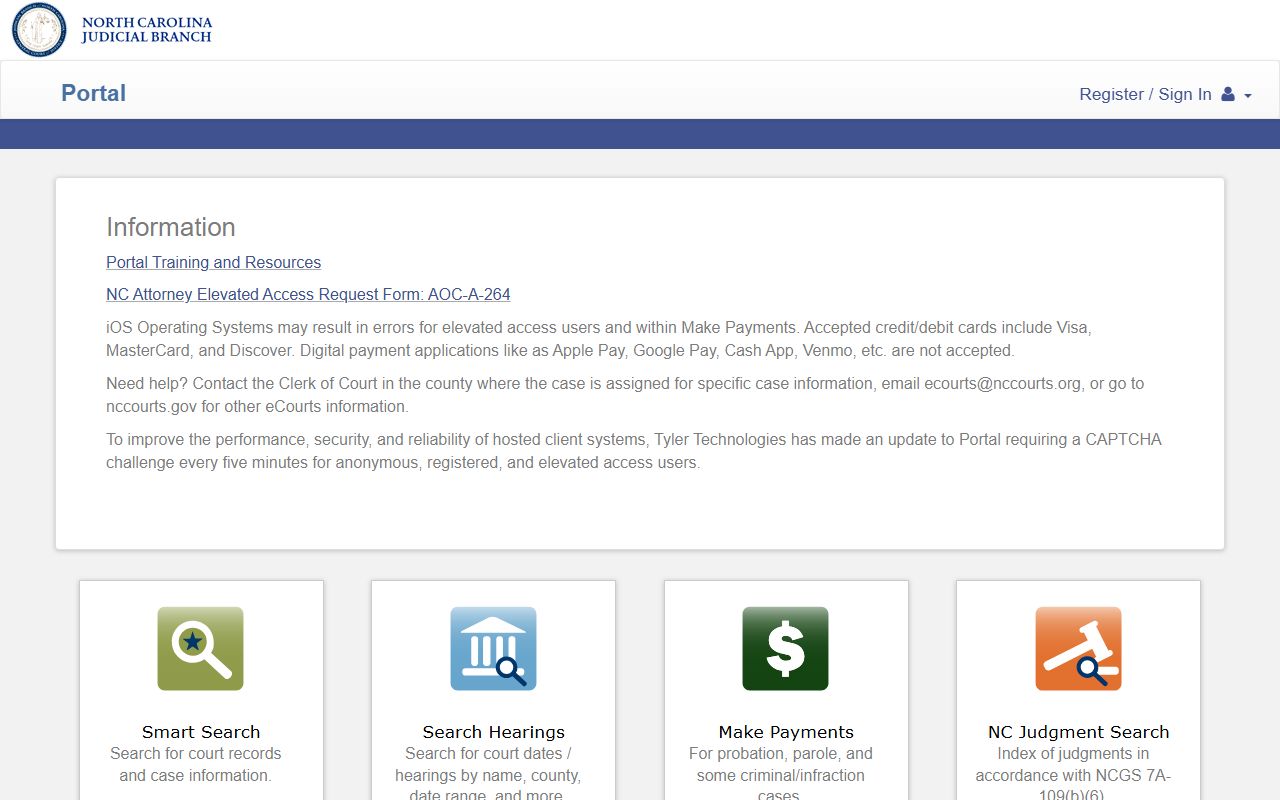
The same screen links to Smart Search, Search Hearings, payments, and judgment search, which covers most Buncombe County court records needs in one place.
- Open the Portal and choose Smart Search.
- Enter a record number, or a name in Last, First Middle Suffix format.
- Open Advanced Filtering Options and set the location to Buncombe County.
- Narrow by case type, case status, or a filing date range if you need to.
- Review the docket entries, hearings, and disposition on the case.
- Request a certified copy from the Clerk of Superior Court if you need an official one.
Wildcard rules trip people up. A case number wildcard needs at least four characters. A person name wildcard needs three or more last name letters plus an asterisk and one or more first name letters plus an asterisk. More on this lives on the Buncombe County court records page.
The Buncombe County Judicial System
North Carolina runs one unified court called the General Court of Justice. It splits into two divisions. The Appellate Division holds the Supreme Court of North Carolina and the North Carolina Court of Appeals. The Trial Division holds Superior Court and District Court. Buncombe County falls in Superior Court District 40 and District Court District 40, and it is also Prosecutorial District 40 for the District Attorney.
Superior Court is the higher trial court. It hears felonies, civil cases worth more than $25,000, and appeals from District Court in misdemeanor and infraction matters. District Court hears misdemeanors, infractions, juvenile cases, domestic and family matters, and civil cases at or below $25,000. Magistrates sit below both. They issue arrest warrants, set bail, and hear small claims up to $10,000, evictions, and other minor matters.
Case flow: Magistrate / Small Claims › District Court › Superior Court › North Carolina Court of Appeals › Supreme Court of North Carolina
The full North Carolina court hierarchy is laid out on the state's courts overview page.
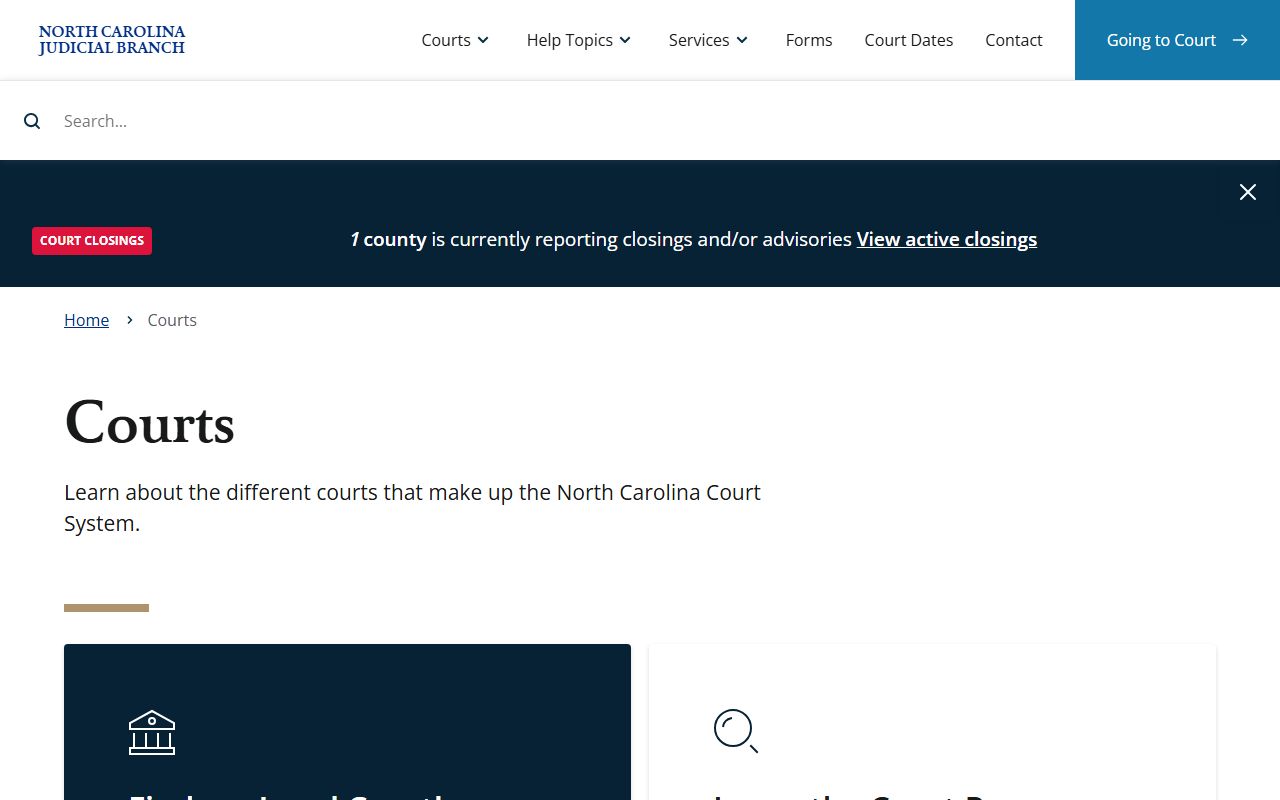
That structure is why a single Buncombe County court records search can pull civil, criminal, family, and probate matters from the same system.
| Court | Jurisdiction | Case Types |
|---|---|---|
| Supreme Court of North Carolina | Highest state court | Final review of state-law questions |
| North Carolina Court of Appeals | Intermediate appellate | Reviews trial courts for legal or procedural error |
| Superior Court (District 40) | Higher trial court | Felonies, civil over $25,000, appeals from District Court |
| District Court (District 40) | Lower trial court | Misdemeanors, infractions, family, juvenile, civil under $25,000 |
| Magistrates / Small Claims | Limited | Small claims to $10,000, evictions, warrants, bail |
Read more about each trial court on the Buncombe County District Court page.
Buncombe County Courthouse
The main state courthouse is the Buncombe County Courthouse at 60 Court Plaza in Asheville. It houses Superior Court, District Court, the Clerk of Superior Court, magistrate functions, and family court. The newer judicial complex is a 118,000-square-foot, four-story building that joined the original 1928 courthouse and added video arraignment, holding cells, and an improved public security entrance. The Register of Deeds, which handles land and vital records, sits a short walk away at 205 College Street.
The official courthouse details live on the N.C. Judicial Branch courthouse page.
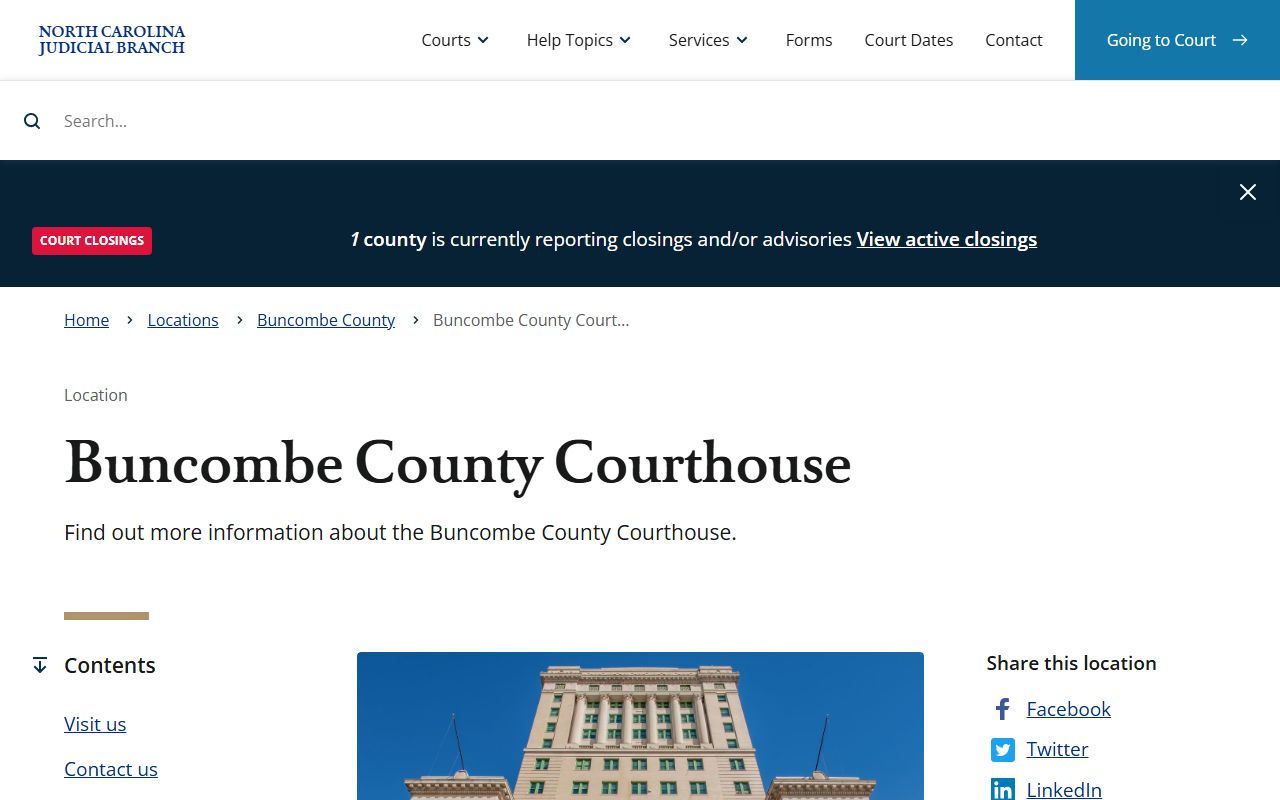
That page lists the address, the main phone line, and the hours, which is where most courthouse visits should start.
Buncombe County Courthouse
60 Court Plaza
Asheville, NC 28801
(828) 259-3400
Mon-Fri 8:00 AM-5:00 PM
Clerk of Superior Court
60 Court Plaza
Asheville, NC 28801-3519
(828) 259-3400
Arrive 30 minutes before a court session. A security checkpoint scans bags, and everyone passes through a metal detector at the entrance.
Types of Court Records Available in Buncombe County
Buncombe County court records cover the full range of cases the trial courts handle. Some come from Superior Court. Some come from District Court. Some, like marriage and land records, are not court records at all and are kept by the Register of Deeds instead. Knowing which office holds what saves a lot of time.
The Clerk of Superior Court files, indexes, and maintains the court records below. Divorce files are court records too, kept by the Clerk and not the Register of Deeds.
- Criminal records - felonies in Superior Court, misdemeanors and infractions in District Court.
- Civil records - cases over $25,000 in Superior Court, under $25,000 in District Court.
- Family and divorce records - divorce, custody, child support, and protective orders in District Court.
- Probate and estate records - wills, estates, and guardianships before the Clerk as judge of probate.
- Traffic records - citations and infractions routed through District Court and the eCourts payment system.
Small claims, evictions, and recovery of personal property go through magistrates and show up in the same eCourts search.
What Buncombe County Court Records Show
A case record in eCourts pulls together the key facts of a case in one place. The exact fields vary by case type, but most public records share a common spine. You will see who is involved, what the case is about, where it stands, and what the court has done so far. Certified official copies still need to come from the Clerk.
| Field | What It Shows |
|---|---|
| Case Number | The unique court file number assigned at filing. |
| Filing Date | The date the clerk accepted the first document. |
| Parties | Plaintiff and defendant, or petitioner and respondent. |
| Charges / Cause | The offense, statute, or civil claim at issue. |
| Disposition | The outcome of a charge or the case. |
| Sentence / Judgment | The penalty or final court decision. |
Some data never shows in public view. Social Security numbers, financial account data, minor identifying details, and sealed juvenile or expunged content are kept out.
Public Access Laws for Buncombe County Court Records
North Carolina starts from a strong open-records position. Chapter 132, the Public Records Act, defines public records broadly and gives the public a right to inspect and copy them. Court records add another layer. They are kept by the Clerk of Superior Court under judicial branch rules, so official certified copies come from the clerk rather than any private database. A handful of statutes carve out what stays confidential.
Key Statutes:
N.C.G.S. § 132-1 - defines public records to include nearly all material made or received in public business.
N.C.G.S. § 132-6 - requires custodians to allow inspection and provide copies promptly after lawful fees are paid.
N.C.G.S. § 7B Article 30 - keeps juvenile court records out of public inspection except by court order.
For the wider framework and how to file a request, see the Buncombe County public records page.
Records That Are Restricted or Confidential
Not every court record is open. Juvenile delinquency and undisciplined adjudications are not public records and stay sealed without a court order. Adoption records are sealed under Chapter 48. Mental health commitments, abuse and neglect files, some domestic violence victim details, sealed warrants, and expunged records are all withheld or redacted from public search.
Expunction removes qualifying records from public access. North Carolina has no single expunction law. The right statute depends on the case result, the offense, and the person's age. A petitioner files in the county where the charge or conviction happened, often with affidavits, notice to the district attorney, and a judge's order. If an expunged item still shows weeks later, the person can contact the clerk where the expunction was granted.
Specialty Courts in Buncombe County
Buncombe County runs several recovery courts in District 40. These are problem-solving courts. They aim to fix the cause of repeat cases rather than just punish them. The N.C. Judicial Branch lists Buncombe as an operational county for both an Adult Treatment Court and a Veterans Treatment Court, and the county page also lists a DWI Treatment Court.
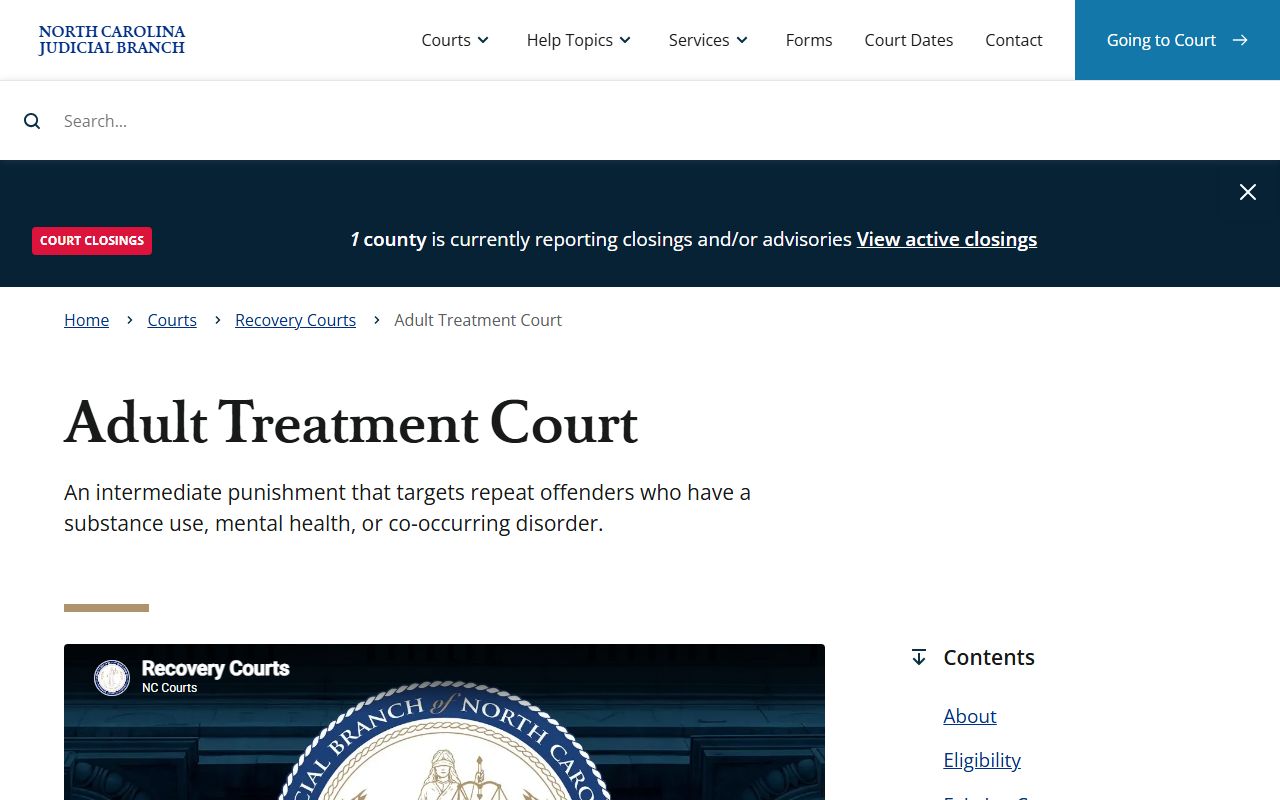
The Adult Treatment Court connects nonviolent, repeat offenders who face jail or prison time with intensive substance use and mental health treatment. The Veterans Treatment Court does the same for military veterans and tries to link them to benefits earned through service. Details on these programs sit on the N.C. Judicial Branch Adult Treatment Court page.
Buncombe also runs Family Court along with mediation programs for custody, visitation, and financial settlement.
Buncombe County Sheriff and Jail
The Buncombe County Sheriff's Office runs the Buncombe County Detention Facility at 20 Davidson Drive in Asheville. The facility holds people for local, state, and federal agencies. Captain Jeffrey Littrell is the facility administrator, and the jail's main line is (828) 250-4550. Inmate lookups go through the county's Police-to-Citizen Inmate Inquiry tool.
For the roster, booking process, and visitation rules, see the Buncombe County inmate records page, and check warrant records for active warrants and orders for arrest. Recent release status is covered on the released inmates page.
Marriage, Divorce, and Probate Records
Marriage licenses and certificates are Register of Deeds records. Divorce and probate are court matters kept by the Clerk of Superior Court. The Register's own FAQ sends divorce and estate questions to the Clerk, so do not confuse the two offices. For details, see the marriage and divorce records page and the probate records page.
- Testator
- A person who makes a will.
- Executor
- The person named to carry out a will and settle the estate.
- Conservator
- A person the court appoints to manage another adult's affairs.
Buncombe County Record Fees
Court copy and certification fees are set by statewide North Carolina court cost rules, so ask the Clerk for current court copy amounts. The Register of Deeds publishes its own fee schedule under state law, and those fees are listed below for the land and vital records that office keeps.
| Item | Amount |
|---|---|
| Certified copy of a recorded instrument | $5 first page + $2 each added page |
| Uncertified copy | $0.25 per page |
| Certified birth, death, or marriage certificate | $10 |
| Marriage license application | $60 |
The full Register of Deeds schedule, set under N.C.G.S. 161-10, is on the county General Fees page.
How to Interpret Buncombe County Court Records
Court files use shorthand. Learning a few terms makes a record far easier to read. A charge is only an accusation. A conviction is a finding or plea of guilt. A disposition is the outcome. "Dismissed with prejudice" means the matter is closed and generally cannot be refiled, while "without prejudice" leaves the door open.
Watch the difference between an arrest and a conviction. An arrest record shows a person was taken into custody. It does not prove guilt. The case may end in dismissal, a plea, a trial, or an acquittal. Always read the disposition before drawing a conclusion from a Buncombe County court record.
Accuracy and Record Limitations
Online court records can lag. New filings, dispositions, and payments take time to post. Sealed and expunged items drop out of public view. If a record looks wrong or out of date, the clerk's office is the place to confirm it.
Note: Confirm any case detail with the Buncombe County Clerk of Superior Court before relying on an online court record for a legal, financial, or personal decision.
History of Buncombe County Courts
The 1928 courthouse still anchors the judicial complex in downtown Asheville. The newer four-story complex opened with a ribbon-cutting on November 7, 2013, adding security upgrades, video arraignment, and more courtroom and office space. It was built to meet the county's court needs for about 30 years. Buncombe is the urban court hub of Western North Carolina, and the Clerk's office reflects that scale with 63 employees across 12 divisions and nine courthouse floors.
Recent history matters for access too. Hurricane Helene disrupted court operations in 2024, and the Chief Justice issued amended orders for several Western North Carolina counties. Weather and emergencies can shift court calendars and filing deadlines, so check current notices before a courthouse trip.
Frequently Asked Questions
How do I search Buncombe County court records online?
Use the North Carolina eCourts Portal Smart Search. Enter a record number or a name in Last, First Middle Suffix format, then open Advanced Filtering Options and select Buncombe County. The Portal supports wildcard searches, but they need a minimum number of characters: four for case numbers and three last-name letters plus one first-name letter with asterisks for names.
Where is the Buncombe County Courthouse?
The courthouse is at 60 Court Plaza, Asheville, NC 28801. The main number is (828) 259-3400, and hours run Monday through Friday, 8:00 AM to 5:00 PM. Patrons enter at street level, and elevators reach all office floors. Plan to arrive 30 minutes early for the security screening.
Who keeps divorce records in Buncombe County?
The Clerk of Superior Court keeps divorce records because divorce is a court matter. The Register of Deeds does not handle divorce files and sends those questions to the Clerk at (828) 259-3400. Divorce filings are District Court family matters and are searchable through eCourts to the extent they are public.
More answers are on the Buncombe County Court Records FAQ page.