
How to Look Up Buncombe County Jail Population Data
The primary source for Buncombe County jail population data is the Buncombe County Sheriff's Office transparency dashboard page. The Buncombe County Sheriff page links directly to five separate dashboards, each measuring a different dimension of the detention population. These are official county-published datasets, not third-party estimates, and they represent the most accurate and up-to-date figures available for public review.
The five dashboards available through the Sheriff page cover distinct measures. Current Daily Populations presents average daily population alongside demographic breakdowns. Daily Population Trends shows ADP over time so viewers can identify patterns across weeks, months, or years. Booking and Release Trends tracks the number of people booked into and released from the Buncombe County Detention Facility for the current and prior years. Active Secured Bonds displays people currently held on secured bond conditions. Pretrial Length of Stay measures how long individuals whose reason for confinement is listed as State Pretrial have been held. Each dashboard is a standalone view, and figures from one do not automatically carry over to another. The dashboard system runs as an interactive data tool, so current values should always be read from the live page rather than from any static copy of the data.
The lead-in screenshot below comes from the Buncombe County Sheriff page, which hosts all five transparency dashboards.
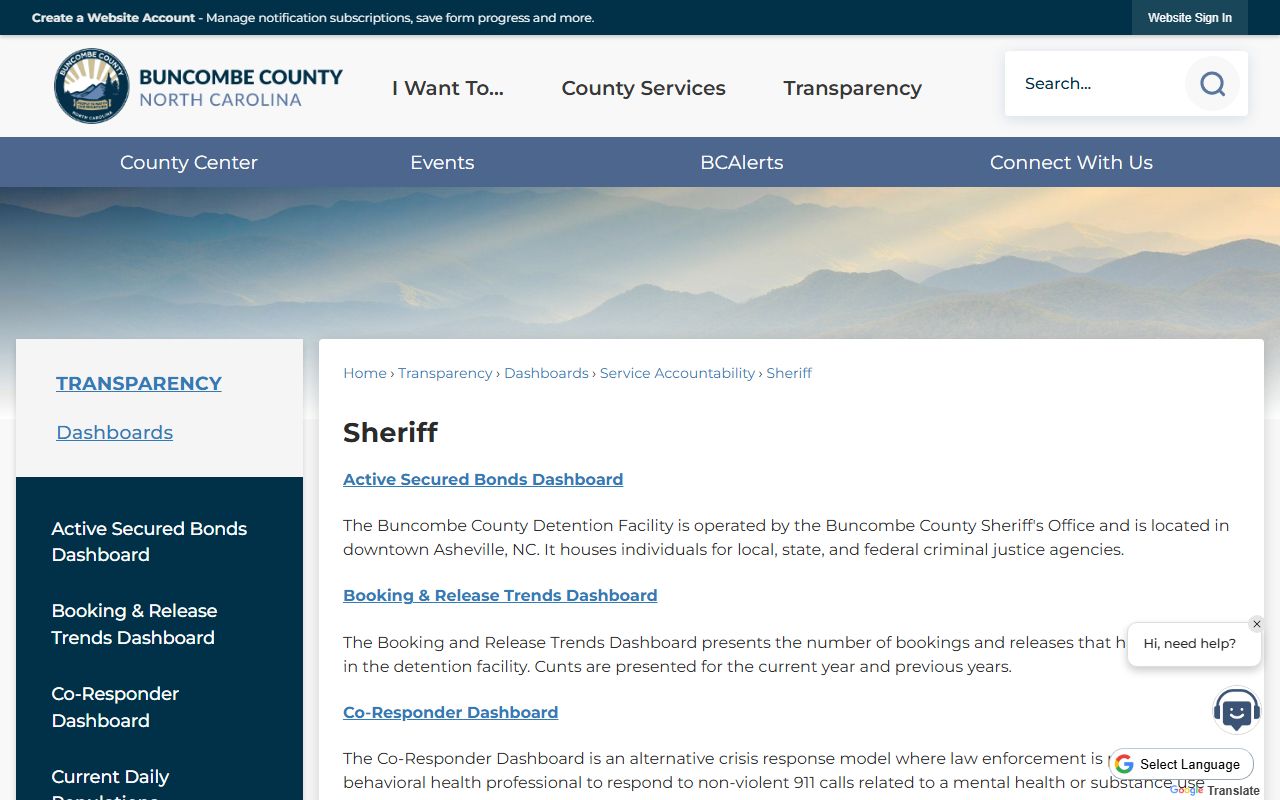
The Sheriff page is the authoritative starting point for any Buncombe County jail population data query, and the five named dashboards are each labeled clearly on that page.
The dashboards are built as interactive data tools, likely powered by PowerBI or a similar platform. Static text captures of those pages do not expose individual numeric values, which is why current figures must be read directly from the live dashboard. Anyone citing Buncombe County population data for research, policy, or legal purposes should access the live dashboard and note the date the data was viewed.
Note: The Booking and Release Trends dashboard covers both the current year and prior years, making it useful for year-over-year comparison without needing to pull archived reports.
Buncombe County Jail Capacity Overview
The Buncombe County Detention Facility at 20 Davidson Drive in Asheville is the sole county jail operated by the Buncombe County Sheriff's Office. The facility holds people for local, state, and federal criminal justice agencies. Specific current capacity figures are published through the official Sheriff dashboards and through facility management reports, which are the proper sources for any current bed count. The table below reflects the only official capacity figures found in public documents, which come from a 2017 official projection summary. Those figures are planning projections for that year and should not be read as current operational capacity.
| Facility | Address | Capacity Notes | Phone |
|---|---|---|---|
| Buncombe County Detention Facility | 20 Davidson Drive, Asheville, NC 28801 | 2017 official projection: 96 female beds; 508 male beds without facility expansion scenario; 604 male beds under expansion scenario. Current operational capacity: see live Sheriff dashboard or contact facility. | (828) 250-4550 |
The 2017 projection also discussed federal holds for the Western District and U.S. Marshals Service under both scenarios. Current federal hold numbers require an updated official report or the live dashboard. The facility administrator is Captain Jeffrey Littrell, and the front desk numbers are (828) 250-4610 and (828) 250-4557.
Because the Buncombe County Detention Facility holds people for local, state, and federal agencies, a single headcount blends pretrial detainees, people serving local sentences, state-sentenced individuals awaiting transfer, and federal holds. Comparing total headcount to total bed count only makes sense if both numbers come from the same official report on the same date.
Average Daily Population at Buncombe County Detention
Average daily population, or ADP, is the standard measure for jail size and usage. A single-day roster count can spike or drop based on weekend booking patterns, court dates, or a large arrest event. ADP smooths those swings by averaging the total daily counts over a period, usually a month or a year. It is a more reliable figure for trend analysis and for comparing one facility to another.
The Buncombe County Sheriff publishes ADP through the Current Daily Populations dashboard, which also includes demographic data. The Daily Population Trends dashboard shows ADP over longer periods. Both are live tools, and the specific figures they show change as new data is added. To find the current ADP for Buncombe County, open the Current Daily Populations dashboard through the Sheriff transparency page. The research file notes that exact numeric values from these interactive dashboards were not extractable in static text capture, so readers should access the live data directly.
Using ADP as the primary metric aligns with how the Bureau of Justice Statistics measures local jail populations nationally, which makes it possible to compare Buncombe County figures to state and national benchmarks once current values are confirmed from the dashboard.
Demographic Breakdown of Buncombe County Jail Population
The Current Daily Populations dashboard on the Buncombe County Sheriff page includes demographic data alongside average daily population figures. Demographic categories typically used in local jail reporting include gender, race, and age group. The Sheriff's dashboard is the official source for current Buncombe County demographic breakdowns, and the figures it displays reflect the live population on the date viewed.
| Demographic Category | Where to Find Current Data |
|---|---|
| Gender | Current Daily Populations dashboard, Buncombe County Sheriff page |
| Race / Ethnicity | Current Daily Populations dashboard, Buncombe County Sheriff page |
| Age Group | Current Daily Populations dashboard, Buncombe County Sheriff page |
Statewide and national research can add context to local demographic data. The Prison Policy Initiative publishes detailed demographic analysis of incarceration patterns in North Carolina and nationally. Its data shows that Black residents are incarcerated at higher rates than their share of the general population at both the state and national level, a pattern documented consistently by researchers across jurisdictions. The Prison Policy Initiative makes state-level data available for researchers and advocates who want to compare county-level figures to state norms.
The screenshot below was captured from the Prison Policy Initiative website, which publishes state and national incarceration research used for contextualizing local jail population data.
State and national demographic data from sources like Prison Policy Initiative is useful for framing Buncombe County figures but should not be substituted for the official county dashboard numbers.
Pretrial vs. Sentenced Population in Buncombe County
People held at the Buncombe County Detention Facility fall into several legal categories. The two most common distinctions are pretrial and sentenced. A pretrial detainee has not yet been convicted. The person may be held because a judge set a secured bond the person could not pay, because a judge ordered no bond, or because the person is awaiting a hearing. A sentenced detainee has already been convicted and is serving a jail term. Other categories include people held on state or federal detainers and people in custody on civil holds or civil commitments.
The Buncombe County Sheriff publishes a dedicated Pretrial Length of Stay dashboard. That dashboard shows length of stay specifically for people whose confinement reason is listed as State Pretrial. It is separate from the broader ADP dashboard and gives a focused picture of how long people wait in jail before their cases move through the court system. Length of stay is a key equity measure because longer pretrial stays can affect employment, housing, and family stability for people who have not been convicted of anything.
| Population Category | Data Source | Notes |
|---|---|---|
| State Pretrial | Pretrial Length of Stay dashboard, Buncombe County Sheriff | Days confined under State Pretrial status; updated live |
| Sentenced / Other Holds | Current Daily Populations dashboard, Buncombe County Sheriff | Includes local sentenced, state sentenced awaiting transfer, federal holds |
When reviewing Buncombe County jail population data, it is important to keep pretrial and sentenced counts separate. Combining them into one figure without labeling the breakdown makes it hard to measure court system efficiency or compare Buncombe to facilities that report differently.
Note: Current pretrial percentage and sentenced percentage for Buncombe County are published on the live Sheriff dashboard; consult that source for specific figures before citing them in any report or legal filing.
Misdemeanor vs. Felony Population in Buncombe County Jail
Jails hold people charged with or convicted of both misdemeanors and felonies, which distinguishes them from state prisons that house only felony-sentenced individuals. In North Carolina, felony cases go through Superior Court and misdemeanor cases go through District Court, but both courts funnel to the same local jail when custody is required. A person charged with a felony may sit in the Buncombe County Detention Facility for months while the Superior Court case proceeds. A person convicted of a misdemeanor may serve a short sentence there as well.
The Sheriff dashboards present population by pretrial status and demographics, but a direct misdemeanor-versus-felony breakdown of current population is not labeled as a separate dashboard tab in the published list. The Booking and Release Trends dashboard may include charge-type information within its booking data, and the Current Daily Populations dashboard may show hold-type breakdowns. To find a current misdemeanor-versus-felony split for the Buncombe County jail, open those dashboards through the Buncombe County Sheriff page and look at the available filter or breakdown options. If that data is not available through the dashboard, contact the facility at (828) 250-4550 or the Sheriff's Office at (828) 250-4503.
Nationally, the Bureau of Justice Statistics reports that the majority of local jail populations are held on felony charges, with misdemeanor holds making up a smaller but significant share. State-level variation is substantial, and county-level data may differ further from state averages based on local prosecution practices and court capacity.
Mental Health and Medical Population at Buncombe County Detention
Mental health and substance use needs are a significant part of the population served by the Buncombe County Detention Facility. The county addresses this through several programs that operate alongside the jail. The Buncombe Jail Diversion and Re-Entry Services office, located at 60 Davidson Drive in Asheville, serves people interfacing with the criminal justice system because of serious mental illness and substance use disorders. The program offers case management, treatment planning, and evidence-based programming. Anyone can refer someone in custody to the program, including the individual themselves, jail staff, attorneys, service providers, judges, and family members.
Two additional programs operate at the jail directly. The JUST Program is a post-booking jail diversion partnership between the Buncombe County Detention Facility and Pretrial Services, focused on individuals with serious or persistent mental health disorders. The Familiar Faces or FUSE program is a multi-agency monthly meeting that coordinates services for people who have had multiple detention bookings, a group that tends to have complex mental health, housing, and substance use needs. More information on diversion and reentry resources is available through the Jail Diversion and Re-Entry Services page.
Specific percentages of the Buncombe County jail population receiving mental health or medical care are not available in static published documents. Those figures, if tracked, would appear in the Sheriff's transparency dashboards or in annual jail inspection reports filed with the North Carolina Department of Health and Human Services or the State Bureau of Investigation. Researchers who need current mental health population data should contact the Sheriff's Office directly or submit a public records request under N.C. Chapter 132.
National and State Context for Buncombe County Jail Data
The Bureau of Justice Statistics publishes the Annual Survey of Jails and the Census of Jails, which are the authoritative national sources for local jail population data. The Bureau of Justice Statistics reports that the U.S. jail population, as measured by ADP, has fluctuated significantly in recent years, falling during the early pandemic period and then recovering partially in subsequent years. As of the most recent BJS Census of Jails data, the national jail incarceration rate was approximately 160 to 220 per 100,000 U.S. residents, depending on the year. North Carolina's rate has historically tracked below the national average, reflecting the state's mix of urban and rural counties with varying local policies and court backlogs.
The screenshot below is from the Bureau of Justice Statistics website, the federal agency that publishes national and state jail population statistics used for contextualizing Buncombe County data.
BJS national figures provide the baseline against which Buncombe County ADP and incarceration rate can be compared, once current local figures are confirmed from the Sheriff dashboard.
| Level | Approximate Jail Rate per 100,000 (National / State Reference) | Source and Notes |
|---|---|---|
| Buncombe County | See live Sheriff dashboard for current ADP; divide by county population to compute local rate | Current values require live dashboard access; static figures not available |
| North Carolina (state) | Historically below national average; confirm current rate via BJS state-level tables | BJS Annual Survey of Jails; state tables at bjs.ojp.gov |
| National (U.S.) | Approximately 160 to 220 per 100,000 (varies by year; see BJS for current figure) | BJS Census of Jails and Annual Survey; figures reflect ADP-based rate |
The Vera Institute of Incarceration Trends, accessible at incarcerationtrends.vera.org, provides county-level historical jail population trends derived from BJS data. Vera's tool is useful for understanding whether Buncombe County's trajectory tracks with state and national trends or diverges in ways that reflect local court policy changes, pretrial reform efforts, or population changes. Note that Vera's data is derived from BJS survey responses, which may have a lag of one to two years behind current conditions.
All three of these sources, BJS, Prison Policy Initiative, and Vera, are research and federal agency sources. They provide context and benchmarks, but Buncombe County's own Sheriff dashboards are the definitive source for current local figures.
Population Trends Over Time at Buncombe County Jail
The Buncombe County Sheriff publishes two dashboards that support trend analysis. The Daily Population Trends dashboard presents ADP over time, allowing viewers to see whether the jail population is growing, shrinking, or holding steady across months or years. The Booking and Release Trends dashboard shows the volume of people booked into and released from the facility for the current year and prior years. Together these two dashboards give a flow-and-stock picture: how fast people are entering and leaving (flow) and how many are present at any given time (stock).
Static extraction of multi-year numeric values from these interactive dashboards was not possible in the research phase for this page. The research file explicitly notes that dashboard numeric values were not extractable in a static text capture, and that anyone making numeric trend claims should open the live PowerBI dashboards or obtain exported values first. A five-year trend line or year-over-year percentage change should be drawn directly from the live dashboard or from an exported dataset, not from secondary summaries.
One major external factor that affected Buncombe County operations in recent years was Hurricane Helene in 2024. The Chief Justice issued amended orders for several Western North Carolina counties following that event, and court calendar disruptions may have had downstream effects on jail population levels during and after the storm. Researchers reviewing multi-year trends should account for that period as a potential anomaly in the data.
For historical context beyond the Sheriff's dashboard window, BJS publishes jail population data by state going back decades. County-level historical data is available through Vera's Incarceration Trends tool, which aggregates BJS survey responses at the county level. Both sources can help situate any trend visible in the local dashboard within a longer-term pattern.
Note: Anyone who needs exported population data for research or policy analysis can contact the Buncombe County Sheriff's Office at (828) 250-4503 or submit a formal public records request under N.C.G.S. Chapter 132.
Searching for Buncombe County Inmate Records by Name
Population dashboards show aggregate numbers, not individual records. To find a specific person currently held at the Buncombe County Detention Facility, use the Buncombe County inmate records page, which covers the Police-to-Citizen Inmate Inquiry tool and explains how to search by name, what information the roster shows, and when to call the facility directly.
Where the Data Comes From
Buncombe County jail population data comes from several tiers of official and research sources. The primary tier is the Buncombe County Sheriff's Office, which publishes five transparency dashboards covering current populations, daily trends, booking and release volumes, secured bonds, and pretrial length of stay. All five are available through the Buncombe County Sheriff page and represent official county data.
The secondary tier consists of state and federal oversight. North Carolina jails are inspected by the state, and inspection reports may include population figures and capacity assessments. The North Carolina Department of Health and Human Services oversees county jail standards, and the State Bureau of Investigation maintains crime and jail data at the state level.
The tertiary tier covers national research sources. The Bureau of Justice Statistics at the U.S. Department of Justice publishes the Annual Survey of Jails and the Census of Jails, which collect ADP, demographics, and program data from local jails across the country. North Carolina is included in these surveys, and county-level data may be accessible through BJS data tools for years when Buncombe County was a survey respondent. The Vera Institute of Incarceration Trends aggregates BJS county-level data into a searchable tool. The Prison Policy Initiative publishes state and national analysis of incarceration demographics, pretrial detention, and policy trends.
When citing Buncombe County inmate population figures, always specify the source and date. Dashboard figures change daily. BJS data reflects survey years that may lag current conditions. A figure labeled as a 2017 projection, as with the 96-female-bed and 508-or-604-male-bed scenario referenced in official planning documents, is not a current operational capacity. Use the live Sheriff dashboard or a current facility report for any figure you plan to publish or use in a legal or policy context.
For broader criminal record research beyond population data, see the Buncombe County arrest records page and the warrant records page. For post-release tracking and notification, see the released inmates page.