
North Carolina Public Records Act Framework
North Carolina's open-records law lives in Chapter 132 of the General Statutes. It defines public records broadly. The law covers documentary material made or received by a state or local agency in carrying out public business. That includes documents, papers, letters, maps, books, photographs, films, recordings, and electronic data. The definition is intentionally wide. Courts, counties, towns, and state agencies all fall under it.
The anchor provision is G.S. 132-1, which defines what counts as a public record. Any material made or received by a public agency in connection with public business is presumed open unless a specific statute carves it out. The burden is not on the requester to prove a record is public. It is on the agency to identify a legal basis for withholding it.
The practical request-and-copy statute is G.S. 132-6. That section requires custodians to permit inspection and examination of public records at reasonable times under reasonable supervision. It also requires them to provide copies as promptly as possible after the requester pays any lawful fees. There is no requirement that you explain why you want the record or give your name, unless the agency has a specific legal basis for asking.
The statute below shows the full text of G.S. 132-1 on the North Carolina General Assembly website, which is the authoritative source for the public records definition.
The N.C.G.S. 132-1 public records definition page shows how the General Assembly structured the definition and which material falls within its scope.
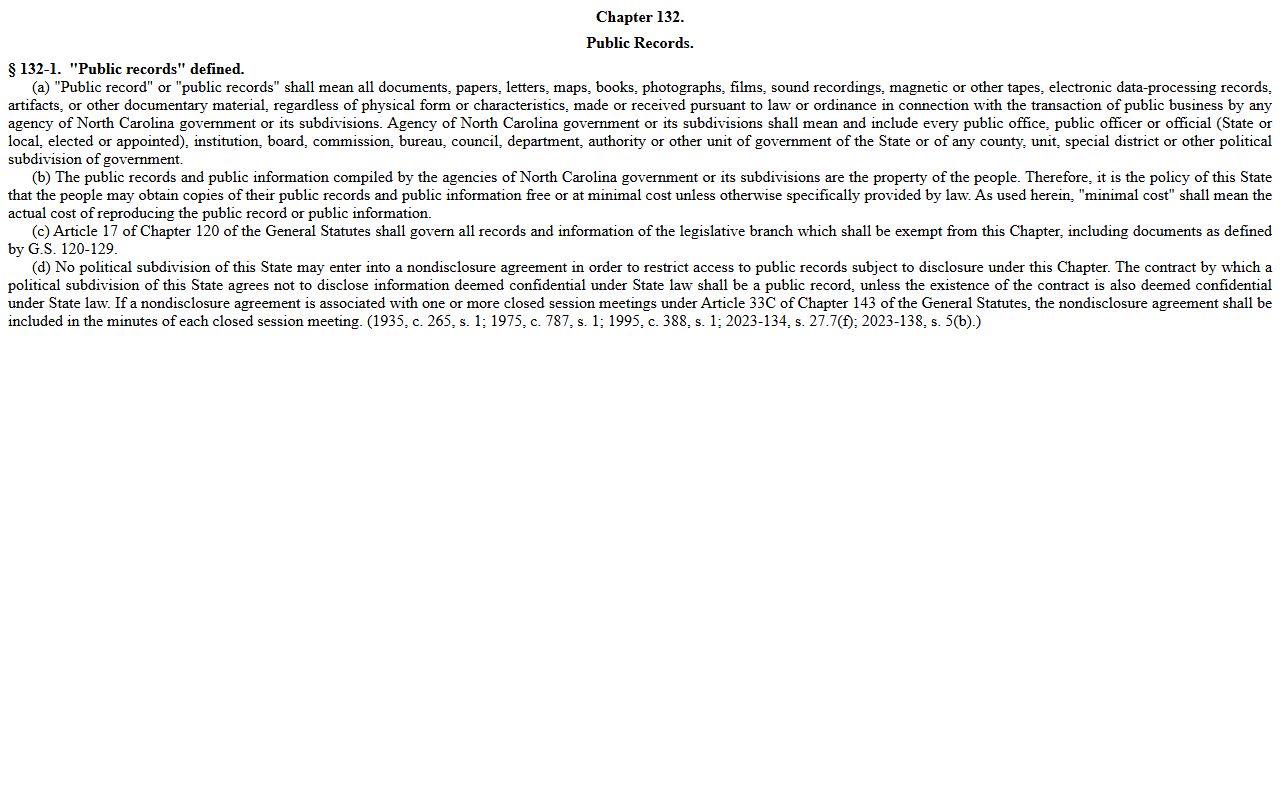
That statutory definition is why nearly everything the Buncombe County Clerk and Register of Deeds hold is presumed accessible unless a specific exemption applies.
One more statute matters for anyone handling sensitive personal data. G.S. 132-1.10 restricts what agencies may include in publicly accessible documents. Social Security numbers, taxpayer identification numbers, driver license numbers, passport numbers, bank account numbers, credit and debit card numbers, and PINs may not appear in public-facing records unless required by law, court order, or redacted to limited digits. Buncombe County offices follow this rule when producing copies.
Note: North Carolina does not set a single fixed number of days for public records responses; the law requires agencies to act "as promptly as possible," which courts have interpreted to mean without unreasonable delay.
Buncombe County Records Beyond the Courtroom
Two local offices keep the county's core public records. The Clerk of Superior Court handles everything tied to court cases. The Register of Deeds handles land, vital, and business records that are never filed in court. Knowing which office holds what saves a trip across downtown Asheville. The Clerk sits at 60 Court Plaza inside the Buncombe County Courthouse. The Register of Deeds is a short walk away at 205 College Street.
The Clerk of Superior Court files, indexes, and maintains court records for every case type that comes before Superior Court and District Court in Buncombe County. The Clerk is also judge of probate, which means estate, guardianship, and competency matters are also clerk records. Divorce files are court records kept by the Clerk, not the Register of Deeds. The Register of Deeds FAQ says exactly that: divorces and probate are court-related matters kept by the Buncombe County Clerk of Court. The Clerk's office runs 63 employees across 12 divisions and nine courthouse floors, and its records reach back through all the case types the county has handled over the years.
The Register of Deeds handles a different set of records entirely. Those records are public in a different sense: they are recorded instruments and vital statistics, not court files. Online deed records at the Register date back to the late 1700s. Documents submitted to the Recording Department by 4:45 PM are recorded that same business day.
Records the Register of Deeds holds include:
- Real property records - deeds, deeds of trust, and mortgages recorded against Buncombe County land.
- Plats - subdivision and survey maps filed by land developers and surveyors.
- Assumed business names - filings for businesses operating under a trade name other than the owner's legal name.
- UCC filings - Uniform Commercial Code financing statements related to secured transactions.
- Vital records - certified birth, death, and marriage certificates; marriage licenses issued by the office.
- Notary records - notary oaths and certifications filed with the Register.
- Military discharges and genealogy records - DD-214 filings and other historical documents used for family research.
Staff at the Register of Deeds cannot give legal advice or supply legal forms. If you need a form prepared or reviewed, that work requires an attorney. The Register's job is to record, index, and provide access to the instruments people bring in.
How to File a Buncombe County Public Records Request
Under G.S. 132-6, any person may request public records from a North Carolina county agency. You do not need a lawyer to do it. You do not need to explain your purpose. The request should go to the custodian of the specific records you want. For court records, that is the Clerk of Superior Court. For land, vital, and business records, that is the Register of Deeds. For other county government records, the request goes to the relevant county department or the county manager's office. Being specific helps. Vague requests take longer because the office has to figure out what you actually want.
- Identify the right custodian. Court records go to the Clerk of Superior Court at 60 Court Plaza. Register of Deeds records go to 205 College Street. Other county agency records go to the department that made or received them. The wrong office cannot fill your request and will have to redirect you.
- Describe the records clearly. Give enough detail for the office to locate what you want. For court records, include the party name and case number if you have it. For deed records, include the grantor or grantee name and approximate year. For vital records, include the person's name, event type, and year.
- Choose your submission method. Most requests can be submitted in person during business hours. The Register of Deeds help desk is reachable at (828) 250-4303, with separate lines for vital records at (828) 250-4300 and recording at (828) 250-4302. The Register also accepts written requests. Spanish-language assistance is available at (828) 250-4307. The Clerk of Superior Court is reached at (828) 259-3400.
- Wait for the response. G.S. 132-6 requires the agency to respond as promptly as possible. There is no fixed statutory deadline in days. In practice, straightforward requests handled in person are often fulfilled on the spot. More involved requests may take additional time, particularly if the office must search files or redact exempt content.
- Pay any fees and receive the records. The agency may charge for copies at the rates set by state law. Pay the amount owed and collect your records. If the agency claims a record is exempt, ask which statute applies. That gives you what you need to evaluate whether to challenge the denial.
The Register of Deeds contact form on the county website asks for your name, email, and a description of your question or request. It also includes a rating field and a spam-trap field. Submitting that form is one way to send a written inquiry before visiting in person.
What to Include in Your Public Records Request
North Carolina does not require a standard form for public records requests. You can write one yourself on any piece of paper or submit it by email. What matters is that the request gives the custodian enough information to find what you want. The table below shows what most Buncombe County offices will need from you to process a records request efficiently.
| Field | Required | Notes |
|---|---|---|
| Your name | Optional by law | Not legally required for most requests, but many offices ask; providing it speeds up follow-up contact. |
| Contact information | Optional by law | Phone or email so the office can reach you if the request needs clarification or records are ready. |
| Description of records sought | Yes | Be as specific as possible: record type, party names, date range, case number, book and page number for deeds, or event details for vital records. |
| Date range | If known | Narrows the search and reduces response time; especially helpful for deed and vital-record requests. |
| Format preference | No | Paper copy, certified copy, or electronic format; the office may not be able to honor every preference, but it helps to state what you need. |
| Fee waiver basis | If requesting | If you believe no fee applies or seek a waiver, state the basis; most standard copy requests do not qualify for waivers. |
For court records, include the case number if you have it. The Clerk can search by party name as well, but a case number makes the search faster and avoids pulling the wrong file.
Buncombe County Register of Deeds Fee Schedule
The Register of Deeds fees are set by G.S. 161-10, the state statute governing what registers may charge. Buncombe states that all fees charged by the Register are set by that statute. The fees below are the Register of Deeds recording and copy fees currently on the county's published schedule. Court copy and certification fees charged by the Clerk of Superior Court are governed by separate North Carolina court cost statutes and may differ.
The G.S. 132-6 page on the General Assembly's website shows how the inspection and copies requirement works alongside those fee structures.
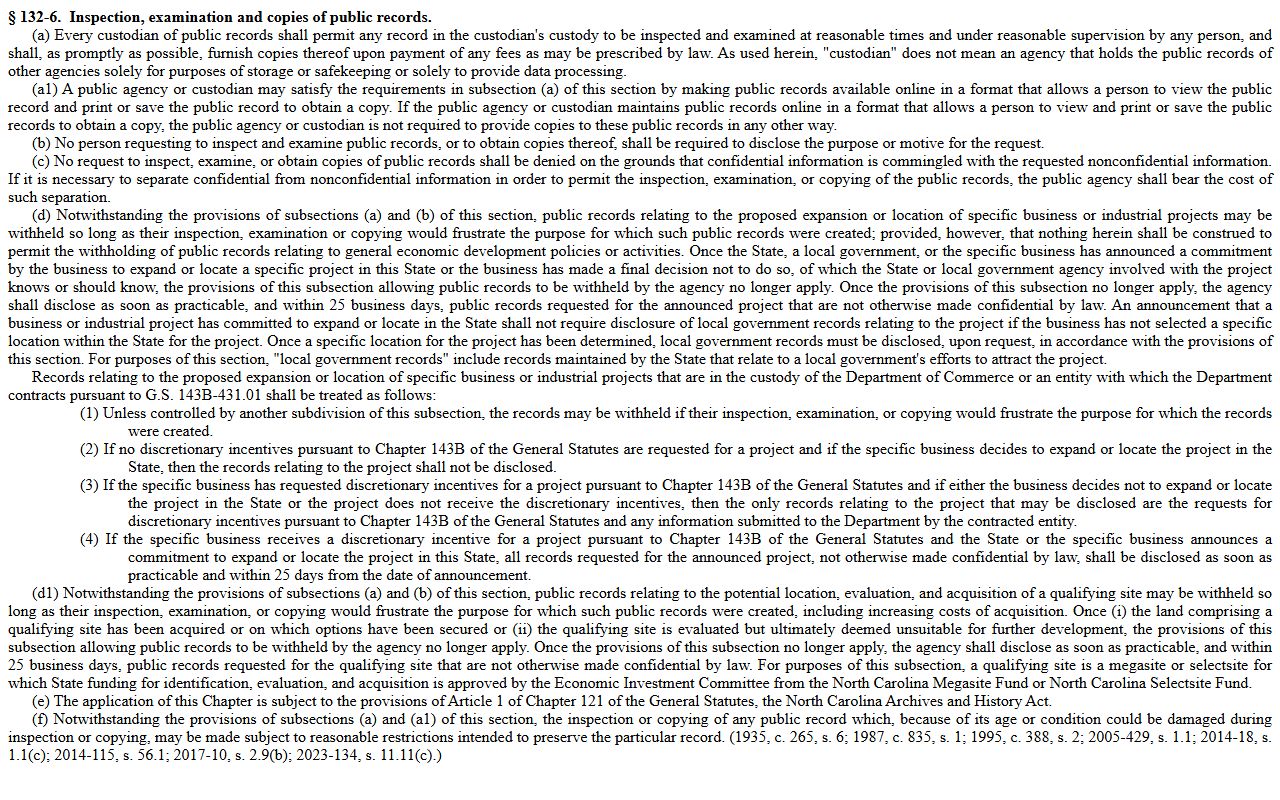
That provision is what gives requesters the legal right to receive copies promptly once fees are paid, which is why Buncombe County offices must produce records rather than just permit viewing.
| Item | Amount |
|---|---|
| Deeds and other papers, first 15 pages | $26 |
| Each additional deed page beyond 15 | $4 per page |
| Extra party names over 20 | $2 per name |
| Deeds of trust / mortgages, first 35 pages | $64 |
| Deeds of trust / mortgages, each additional page | $4 per page |
| Nonstandard documents | $25 |
| Multiple instruments fee | $10 |
| Certified copies of recorded instruments | $5 first page + $2 each additional page |
| Uncertified copies of recorded instruments | $0.25 per page |
| Plats per page | $21 |
| Plat certified copy | $5 |
| Plat uncertified copy | $1.50 |
| UCC filing, 1-2 pages | $38 |
| UCC filing, 3-10 pages | $45 |
| UCC filing, over 10 pages | $45 + $2 per page over 10 |
| Certified birth or death certificate | $10 |
| Certified marriage certificate | $10 |
| Marriage license application | $60 |
| Notary qualification and oath | $10 |
| Notary certification | $5 |
Recording fees are paid when you submit a document for recording. Copy fees are paid when you request a copy. Vital record fees apply when you request a certified certificate from the Register. For marriage records specifically, the license fee covers the application, and a separate fee applies if you later need a certified copy of the certificate.
Register of Deeds Online Records Search
The Register of Deeds runs its own online records portal. Deed records go back to the late 1700s in the digital system, which makes Buncombe one of the deeper online land-record archives in Western North Carolina. The portal is searchable by grantor name, grantee name, document type, and date range. Anyone can search for free without an account.
The Buncombe County Register of Deeds online records site is the public search interface for deeds, plats, assumed business names, UCC filings, and other recorded instruments.
That portal is the fastest way to find a deed or plat without visiting the office, though certified copies still require a formal request and the applicable fee.
The Register's online system does not include vital records in the public search. Birth, death, and marriage certificates are restricted to eligible requesters even though they are maintained by the office. If you need a certified vital record, contact the vital records line at (828) 250-4300 or visit in person. The office is open Monday through Friday, 8 AM to 5 PM. Documents submitted to the Recording Department by 4:45 PM are recorded the same business day.
For court records, including arrest records, civil cases, and family court files, the search goes through the North Carolina eCourts Portal rather than the Register. The Clerk and the Register are separate offices with separate systems. The Register's staff cannot pull court files, and the Clerk cannot pull deed records.
Note: The Register of Deeds staff cannot give legal advice or supply legal forms for any transaction involving the records they maintain.
Response Timelines and Denials
North Carolina's public records law does not set a fixed number of days for an agency to respond. G.S. 132-6 says the custodian must provide access and copies "as promptly as possible." What that means in practice depends on the complexity of the request and the office's workload. A simple in-person request for a deed copy at the Register of Deeds is usually handled immediately. A request involving many pages of records, redaction review, or a legal question about exemptions may take days or longer.
If an agency denies your request, it should tell you the legal basis. The exemption must come from a specific statute, not a general preference for privacy. Common bases for denial in Buncombe County include the juvenile records statute at G.S. 7B Article 30, the adoption sealing statute at Chapter 48, expunction orders, and the personally identifiable information protections in G.S. 132-1.10.
If you believe a denial is wrong, you have options. You can ask the agency to reconsider and identify the specific statute it is relying on. You can contact the North Carolina Attorney General's office, which has a public records section that handles complaints. You can also file a civil action in Superior Court. A court can compel the agency to produce records and may award attorney's fees if the refusal was unreasonable. Before going that route, a written letter to the agency head identifying the specific record and asking for the legal basis of denial often resolves the issue without litigation.
Buncombe County Records That Are Withheld or Restricted
Some Buncombe County records are confidential by statute. The starting point is always access, but these categories stay closed or redacted regardless of who asks. Knowing them in advance avoids time spent requesting something the law does not allow.
Juvenile delinquency and undisciplined adjudications are not public records under G.S. 7B Article 30. They may not be disclosed without court authorization. Adoption records are sealed under Chapter 48 and are not open to inspection except through procedures that statute authorizes. Expunged records are removed from public access after the court grants an order; if an expunged item still shows up weeks later, the person may contact the clerk where the expunction was granted.
Other restricted categories include:
- Mental health commitments - incompetency, guardianship medical details, and involuntary commitment records are restricted.
- Abuse, neglect, and dependency records - these family court files involving children are sealed from public view.
- Domestic violence victim information - certain identifying details about protected parties in protective order cases may be withheld.
- Grand jury proceedings - grand jury records, including sealed indictments, are not public until unsealed by court order.
- Confidential informant information - law enforcement records identifying informants are withheld for safety and operational reasons.
- Personnel records - employee personnel files held by county agencies carry their own exemption under state law.
Documents containing Social Security numbers, financial account data, or other personally identifiable information protected by G.S. 132-1.10 are either withheld or produced with that information redacted. If a document contains both public and protected content, the office should produce the public portions with the protected sections blacked out rather than withhold the whole document.
For the full list of expunction statutes that apply in Buncombe County, including eligibility rules for specific offense types, see the Buncombe County court records page, which covers the expunction process in detail alongside other public access law topics.
Marriage, Divorce, and Vital Records Access
Marriage licenses and marriage certificates are Register of Deeds records. The license is issued at 205 College Street and is valid for 60 days from the date issued. Both parties must appear in person during the application, which is accepted between 8 AM and 4:30 PM. A certified marriage certificate costs $10. For more on the marriage license process, see the Buncombe County marriage and divorce records page.
Divorce records are a different matter. Divorce is a court case, and the file belongs to the Clerk of Superior Court, not the Register of Deeds. The Register's own FAQ redirects divorce questions to the Clerk. Searching for a divorce record means searching the eCourts Portal or contacting the Clerk's office at (828) 259-3400. Certified copies of court records, including divorce decrees, come from the Clerk, not from 205 College Street.
Birth and death certificates are maintained by the Register but are restricted to eligible requesters. North Carolina limits certified vital record copies to the person named in the record, close family members, legal guardians, and others with a legitimate purpose. A certified birth or death certificate costs $10. Walk-in requests go to the vital records line, and the office processes same-day requests when possible during normal hours.