
What Buncombe County Probate Covers
Probate is the legal process that transfers a deceased person's property and settles their debts under court supervision. In Buncombe County, the Clerk of Superior Court acts as the judge of probate for all such matters. This is not a separate court with separate judges. The Clerk, Jean Marie Christy, presides over probate and special proceedings out of the same courthouse where criminal and civil cases are heard. The Clerk's office has 63 employees organized across 12 divisions and nine courthouse floors, reflecting the scale of the work it handles for the county.
The Clerk's probate role is broader than most people expect. It covers the admission of wills to probate, estate administration whether or not there is a will, the appointment of personal representatives, the auditing of estate accountings, and the removal of personal representatives when necessary. Beyond classic estate work, the Clerk also presides over incompetency proceedings, adult guardianship and conservatorship cases, certain trust administration matters, foreclosure and partition special proceedings, legitimations, name changes, and adoptions. The Clerk page describes this scope explicitly, and it means that many legal matters that would go to a separate probate court in other states are handled by the same office that keeps Buncombe's criminal and civil court files.
One point that causes confusion: the Register of Deeds is not involved in probate or estates. The Register handles land records, marriage licenses, birth and death certificates, and recorded instruments. The Register's own FAQ directs any question about estates or probate to the Clerk of Superior Court at (828) 259-3400. If you are looking for a filed will or an estate administration record, the Clerk is the right office.
Probate Terms Used in Buncombe County Filings
Probate filings use legal language that can be unfamiliar. The terms below appear throughout Buncombe County estate and guardianship records and in the Clerk's office communications. Knowing them makes a court file much easier to read.
- Testator
- A person who made and signed a valid will. When that person dies, the Clerk determines whether the document meets North Carolina's legal requirements before it is admitted to probate.
- Executor
- The person named in a will to carry out its instructions, pay debts, and distribute assets. In North Carolina the executor is formally called the personal representative after the court issues letters testamentary.
- Administrator
- A personal representative appointed by the Clerk when a person dies without a will (intestate) or when the named executor cannot or will not serve. The administrator performs the same duties as an executor.
- Intestate
- Dying without a legally valid will. North Carolina's intestacy statutes then determine how the estate is distributed among surviving relatives.
- Guardianship
- A court-supervised arrangement in which the Clerk appoints a guardian to make personal and legal decisions for an adult who has been found legally incompetent. The Clerk presides over both the incompetency proceeding and the resulting guardianship.
- Conservatorship
- A court order giving a named person authority to manage the financial affairs and property of an adult who cannot do so. In North Carolina the conservator is sometimes called a guardian of the estate, and the Clerk's office oversees those accountings.
Note: Letters testamentary and letters of administration are the official documents the Clerk issues to authorize a personal representative to act on behalf of an estate. Banks and transfer agents typically require them before releasing assets.
Buncombe County Probate Record Categories
The Clerk of Superior Court maintains a range of probate and special-proceeding files. Each category represents a distinct type of matter that goes through the Clerk's probate docket. The list below comes directly from the research gathered from official Buncombe and N.C. Judicial Branch sources.
- Wills offered for probate - original will documents submitted to the Clerk for admission to the court record.
- Estate administration applications - petitions to open an estate, with or without a will.
- Oaths and letters testamentary or of administration - the formal documents authorizing a personal representative to act.
- Inventories and accountings - estate inventories listing assets and periodic accountings the personal representative files with the Clerk.
- Year's allowance - a statutory claim a surviving spouse or child may file for support from the estate during administration.
- Summary administration and small estate administration - simplified processes available for qualifying smaller estates that do not need the full administration procedure.
- Guardianship of adults and minors - petitions to appoint a guardian, subsequent accountings, and orders from the Clerk.
- Incompetency proceedings - cases where a party seeks a court finding that an adult can no longer manage personal or financial affairs.
- Foreclosures and partitions as special proceedings - certain mortgage foreclosures and property partition actions filed as special proceedings before the Clerk.
Trust administration matters may also come before the Clerk in certain contexts. Adoptions and legitimations round out the special-proceedings docket. For divorce and marriage records, which are separate categories, see the marriage and divorce records page.
How to Search Buncombe County Probate Records Online
The North Carolina eCourts Portal is the starting point for any online probate records search. All 100 North Carolina counties, including Buncombe, have been on the Enterprise Justice and Odyssey case management platform since October 13, 2025. The Portal offers two tools that are most useful for probate: Smart Search for case and party lookups, and Search Hearings for upcoming probate court dates. The Portal is free to use but requires JavaScript and cookies, and it displays a CAPTCHA challenge every five minutes.
The N.C. Judicial Branch services page explains what each portal tool does and how to navigate them. The screenshot below comes from that page.
For a full view of available portal services, see the N.C. Judicial Branch services page.
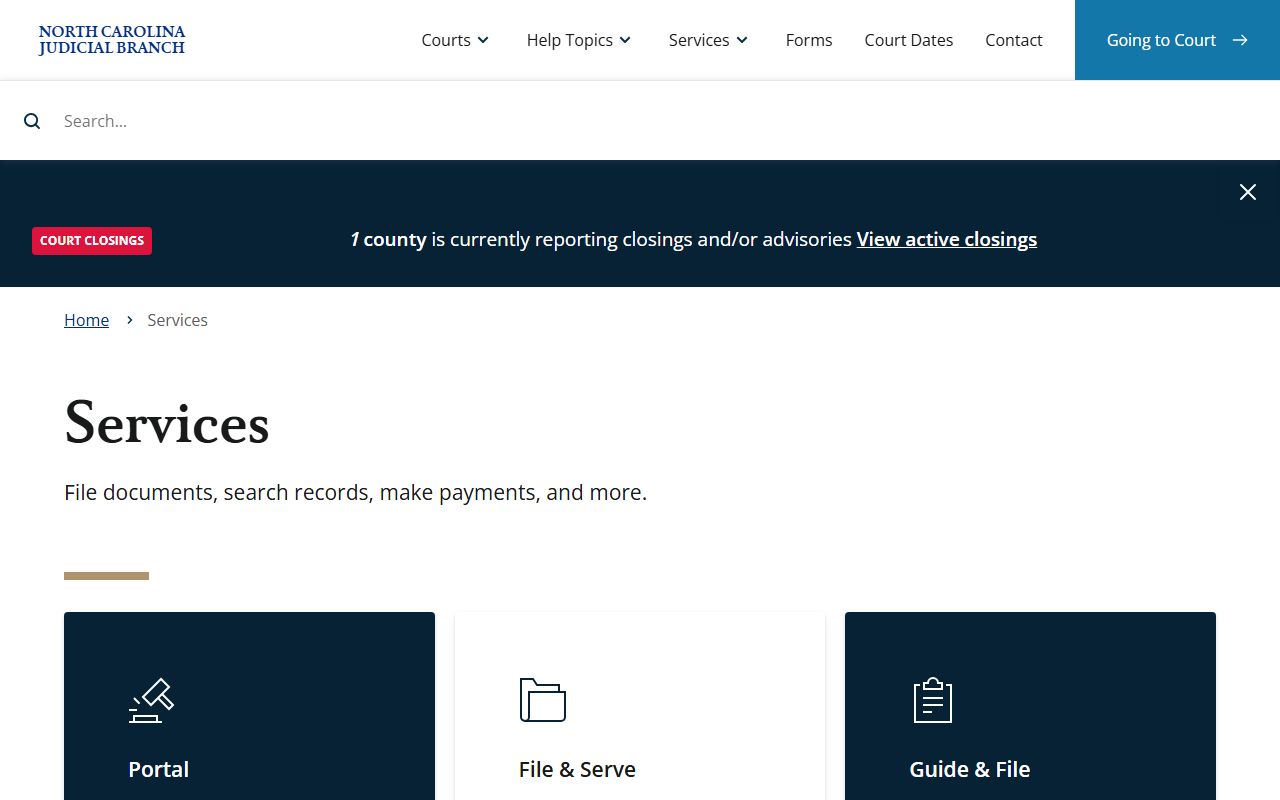
That services page links directly to Smart Search and Search Hearings, which are the two tools most useful for locating Buncombe County probate and estate case information.
The step-by-step process below covers both a case search and a hearing search for probate matters.
- Go to the North Carolina eCourts Portal and select Smart Search from the main dashboard.
- Enter a party name in Last, First Middle Suffix format, or enter a case number if you have it. For a wildcard name search, use at least three characters for the last name plus an asterisk and at least one character for the first name plus an asterisk.
- Open the Advanced Filtering Options panel and set the location filter to Buncombe County so results are limited to local filings.
- Filter by case type if the Portal allows you to narrow to estate or special-proceeding cases. You may also add a filing date range to narrow large result sets.
- Review case information shown in the results. Expect to see the case number, party names, case type, filing date, case status, and any scheduled hearing entries.
- To find an upcoming probate hearing, return to the Portal dashboard and select Search Hearings instead of Smart Search. Set Select Location to Buncombe County. Under Select Hearing Types, choose Probate or Mental Health to filter to the relevant docket.
- If you need certified copies of a will, letters, accountings, or other probate documents, contact the Clerk of Superior Court directly. Online portal views are not certified copies and are not accepted as official records in legal proceedings.
The Search Hearings tool lets you search by party name, attorney, judicial officer, courtroom, or case number, and you can combine the Probate or Mental Health hearing type with a date range to pull a specific probate calendar.
Buncombe County Probate Search Hearings Fields
The Search Hearings form in the eCourts Portal has several fields. For probate matters, the key selections are the location and hearing type. The table below shows the full field set as documented from the Portal.
| Field Label | Type | Notes for Probate Use |
|---|---|---|
| Select Location | Dropdown / multi-select | Choose Buncombe County to limit results to the Asheville courthouse. |
| Select Hearing Types | Dropdown / multi-select | Select Probate or Mental Health for estate, guardianship, and incompetency matters. |
| Select Search Types | Dropdown | Options include Case Number, Party Name, Business Name, Attorney Name, Attorney Bar Number, Judicial Officer, and Courtroom. |
| Last Name / First Name | Text | Required for party or attorney name searches. Sounds Like checkbox available for phonetic matching. |
| Judicial Officer | Dropdown | Filter by a specific judge or clerk assigned to the hearing. |
| Courtroom | Conditional | Available when the Courtroom search type is selected. |
Questions about the Portal itself can go to the N.C. Judicial Branch eCourts page or to the Clerk's office directly.
Probate Court Contact for Buncombe County
There is no stand-alone probate courthouse in Buncombe County. All probate and special-proceeding matters are filed with and presided over by the Clerk of Superior Court at the main Buncombe County Courthouse on Court Plaza in downtown Asheville. The Clerk's office is the place to file petitions, pay fees, pick up certified copies, and ask procedural questions. More detail on the Clerk's full range of duties is on the Clerk of Superior Court page.
Clerk of Superior Court (Judge of Probate)
60 Court Plaza
Asheville, NC 28801-3519
(828) 259-3400
Mon-Fri 8:00 AM-5:00 PM
Plan to arrive at least 30 minutes before you need to file or pick up documents. Everyone entering the courthouse passes through a bag scan and metal detector at the street-level entrance. Elevators reach all office floors.
Probate Filing Fees in Buncombe County
No Buncombe-specific probate fee schedule was published on the official local pages reviewed during research. Probate filing fees in North Carolina are set by statewide court cost statutes and the N.C. Judicial Branch Estates fee schedule rather than by individual counties. The amounts that apply to opening an estate, filing an accounting, or requesting certified letters are the same across the state. Before filing, confirm the current fee amounts directly with the Buncombe County Clerk of Superior Court at (828) 259-3400 or check the N.C. Judicial Branch services page for the current Estates fee schedule. The Clerk can also tell you whether a particular matter qualifies for a reduced or waived fee through a Petition to Proceed as an Indigent, which is one of the forms available through Guide & File.
Note: Register of Deeds fees are set separately under N.C.G.S. 161-10 and cover recorded instruments, vital records, and marriage licenses. Those fees do not apply to probate filings at the Clerk's office.
Guide & File Probate Options for Buncombe County
The N.C. Judicial Branch offers Guide & File as a free online tool that helps self-represented people prepare court documents by answering guided questions. The Clerk's page for Buncombe County lists several Guide & File options that are directly relevant to probate and special proceedings. These tools do not file documents for you, but they generate the forms needed to start certain common matters.
Using Guide & File can save time for people who are filing a simple estate matter or petition without an attorney. The forms it produces still need to meet court requirements, and any printed or electronically submitted documents must comply with the Clerk's procedures. If the matter is complex, contested, or involves significant assets, consulting an attorney is advisable before relying on a self-help form.
Guide & File probate and special-proceeding options listed on the Buncombe Clerk page include:
- Year's Allowance - for a surviving spouse or child seeking a statutory support claim from the estate.
- Summary Administration - a simplified estate process available for qualifying estates.
- Small Estate Administration - for smaller estates that meet the threshold for the simplified affidavit procedure.
- Adult Guardianship - to start the process of seeking a guardian for an adult who can no longer manage personal decisions.
- Adult Name Change - to file a name-change petition as a special proceeding before the Clerk.
- Petition to Proceed as an Indigent - to request a fee waiver for qualifying filers who cannot afford court costs.
Access to Guide & File and other self-help tools is available through the N.C. Judicial Branch services page.
What Buncombe County Probate Records Show
Probate files at the Clerk's office contain the documents generated throughout an estate or special-proceeding matter. What you find in a file depends on the type of proceeding and how far it progressed. A basic testate estate file typically includes the original will submitted for admission, the application to open the estate, the oath of the personal representative, letters testamentary or of administration, an inventory of estate assets, accountings, and an order closing the estate. Guardianship files include the petition, medical reports or findings supporting the incompetency determination, the order of appointment, and periodic accountings the guardian files to show how they managed the ward's affairs.
Keep in mind that not all probate information is public. Some guardianship, incompetency, mental health, and adoption records are restricted. A case may appear in the eCourts search results but have limited public detail if the underlying file contains protected medical information or involves confidential proceedings. More on restricted records is in the next section. For the full Buncombe County court records framework, including how public access works across record types, see that page.
Restricted Buncombe County Probate and Guardianship Records
Several categories of probate-related records carry access restrictions under North Carolina law. Adoption records are sealed under Chapter 48 of the General Statutes and are not available to the general public. Mental health commitments, incompetency proceedings that include detailed medical evaluations, and guardianship records that contain personal health information may be withheld or redacted from public access. Juvenile records, including any minor guardianship matters filed under Chapter 7B, are not public records under Article 30 of that chapter and may not be disclosed without a court order.
When a probate or special-proceeding file is restricted, the case may still appear in the eCourts search results, but the documents and certain party details will not be visible in the public portal view. A party who is a named participant in a restricted case, or an attorney of record, may have access to more detail than the general public. Questions about what is available in a specific restricted file should go to the Clerk's office at (828) 259-3400. See the Buncombe County public records page for the broader legal framework governing access to confidential records.
One recent development worth noting: Buncombe Register of Deeds announced in 2025 that it would begin issuing adoptive birth certificates in 2026. That process involves vital records at the Register's office, not probate records at the Clerk's office, but the two can be part of the same adoption proceeding.
Note: If you have a question about whether a specific probate file or document is accessible, contact the Clerk of Superior Court before making a trip to the courthouse. Some records require advance notice to retrieve from storage.