
Buncombe County Arrest Records and Bookings
An arrest record starts the moment someone is taken into custody and processed at the Buncombe County Detention Facility at 20 Davidson Drive in Asheville. The Buncombe County Sheriff's Office operates the facility. Sheriff Quentin Miller leads the office, and Captain Jeffrey Littrell serves as facility administrator. The facility holds people for local, state, and federal criminal justice agencies. When a person is booked, the intake process captures identity information, the charges presented, property intake, classification, and a medical screening. A magistrate then handles the initial appearance and sets bail. That booking record becomes the foundation of what people call an arrest record.
Arrest records and criminal court records are related but they are not the same thing. An arrest record reflects what the Sheriff's booking system captured at the time of custody. A criminal court record is what the Clerk of Superior Court keeps once charges are formally filed in Superior or District Court. The two systems overlap but run on different tracks. For full case files, charges, motions, and dispositions, the Buncombe County court records page covers the eCourts Portal and how to access those files. The arrest record only tells you someone was booked. It does not tell you how the case ended.
Note: Not every booking leads to a formal court charge. Some arrests end with a citation or a release before charges are filed.
How to Search Buncombe County Arrest Records
The fastest way to find a current Buncombe County arrest record is the Police-to-Citizen Inmate Inquiry tool, which the Sheriff's Office runs at buncombecountyso.policetocitizen.com. The site shows who is currently in custody at the detention facility. It is an Angular web application, so JavaScript must be enabled. If the portal is unavailable or a custody status is urgent, call the detention facility directly at (828) 250-4550. For questions about a specific case number or court date, the Clerk of Superior Court main line is (828) 259-3400.
- Open the Buncombe County Police-to-Citizen Inmate Inquiry page in a browser with JavaScript enabled.
- Enter a name or use any search or filter controls visible in the catalog view to narrow results.
- Review the listing for the person's current custody status, charges on file, and booking information.
- If the person is not listed or you need more detail, call the Detention Facility at (828) 250-4550 or the Sheriff's Office main line at (828) 250-4503.
- For older arrest history that may have moved into the court system, search the North Carolina eCourts Portal Smart Search using the person's name and a Buncombe County filter.
State-level criminal history that goes beyond a current booking requires a separate search. The North Carolina Department of Adult Correction runs the NC DAC Offender Public Information portal, which covers people under active or past state supervision. That search is separate from the county booking system. The Sheriff's transparency dashboard also links to Booking and Release Trends data that shows counts of bookings and releases for the current and prior years, which is useful for tracking volume but not for individual records.
The NC DAC Offender Public Information search portal is a starting point for anyone looking up a person under state supervision, as shown on the NC DAC offender search page.
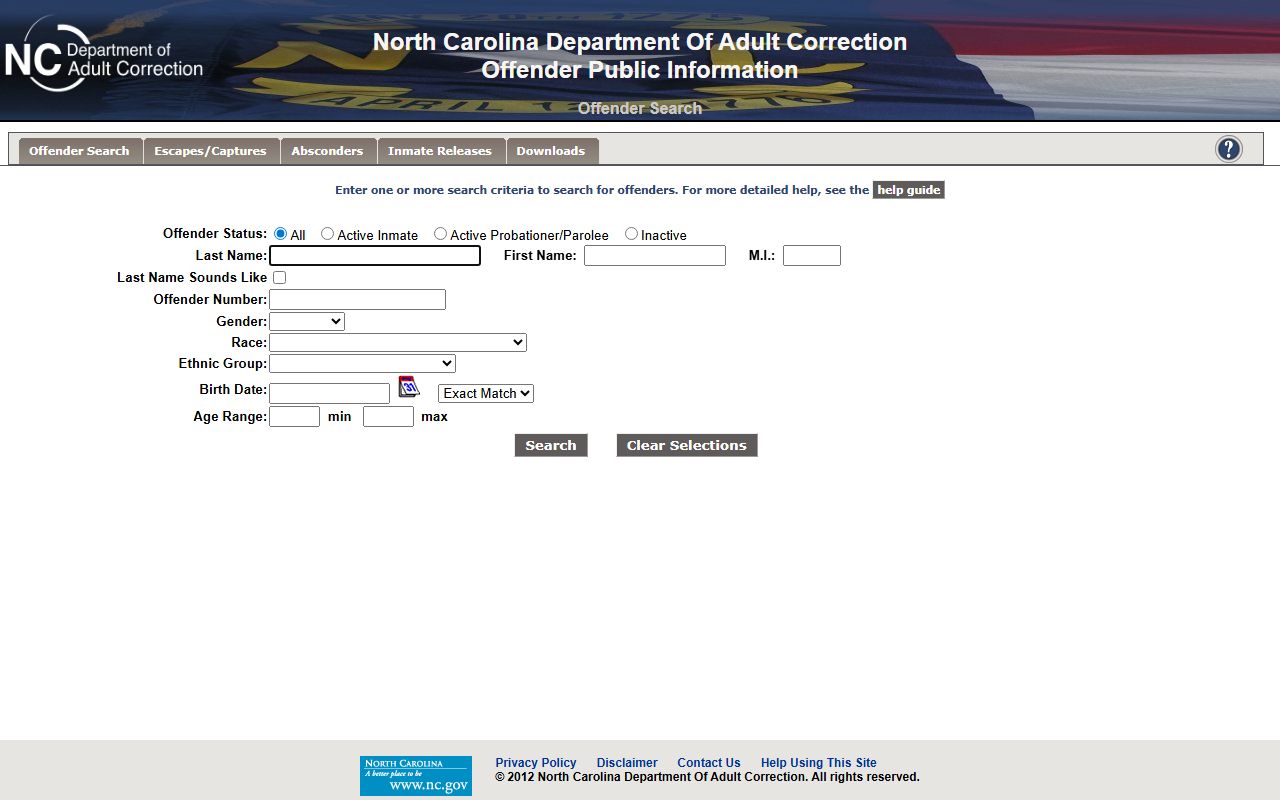
That portal searches across all people under North Carolina Department of Adult Correction supervision, which includes people on parole or probation after a Buncombe County conviction as well as those in state prison.
Arrest Records vs. Buncombe County Criminal Court Records
People often use "arrest records" and "criminal records" as if they mean the same thing. They do not. The distinction matters both for what you find and for what conclusions you can draw. An arrest record lives in the Sheriff's booking system. A criminal court record lives with the Clerk of Superior Court. Both are public under North Carolina law, but they contain different information and are created at different points in the process. An arrest record can exist with no corresponding conviction and sometimes with no charges ever filed.
| Arrest Record | Criminal Court Record | |
|---|---|---|
| Source | Buncombe County Sheriff / Law Enforcement | Clerk of Superior Court |
| Created When | At booking into the Detention Facility | When charges are formally filed in court |
| Primary Contents | Booking data, charges at intake, custody status | Pleadings, motions, hearing dates, disposition, sentence |
| Where to Search | Police-to-Citizen Inmate Inquiry; Sheriff dashboard | NC eCourts Portal Smart Search |
| Proves Guilt? | No | Only if disposition shows conviction |
Full criminal case files, including what happened after a booking, are accessible through the Buncombe County court records search. The eCourts Portal covers all 100 North Carolina counties and lets you filter by Buncombe County to narrow results to local cases.
Charges vs. Convictions in Buncombe County
A charge is an accusation. A conviction is a proven or admitted finding of guilt. Buncombe County criminal records show both, but they carry very different legal weight. When someone is booked at the Detention Facility, the intake record shows the charges presented at the time of arrest. Those charges may change, be reduced, be dismissed, or result in a conviction at trial or by plea. None of that happens at the booking stage. Reading a booking record as proof of guilt is a mistake. The disposition field in the eCourts case record is where you find what actually happened to a charge.
| Charge | Conviction | |
|---|---|---|
| Legal Stage | Accusation or indictment | Verdict or guilty plea |
| Standard | Probable cause to arrest | Proof beyond reasonable doubt (or admission) |
| Who Decides | Law enforcement or magistrate | Judge or jury |
| Public Record | Yes, through booking system | Yes, through eCourts case record |
| Can Be Expunged | Yes, under certain statutes | Yes, under more limited statutes |
Superior Court in Buncombe County handles felony charges. District Court handles misdemeanors and infractions. Both are part of Judicial District 40. Active warrants that have not yet led to a booking are a separate question; see Buncombe County warrant records for how those are tracked.
What Buncombe County Arrest Records Show
The Buncombe County Detention Facility booking process captures several data points that may appear in the public inmate catalog. North Carolina's public records law under G.S. 132-1 defines public records broadly, and arrest and booking records generally fall within that definition. The Police-to-Citizen portal is an Angular application; the exact field set visible in the public view may vary, but P2C jail systems of this type typically display name, age, booking date, charges listed at intake, bond information, and custody status. Call the facility at (828) 250-4550 if you need to confirm a specific piece of information the portal does not show.
Arrest records do not include court dispositions, sentence terms, or probation conditions. Those details sit in the Clerk's court files. They also do not include sealed warrant details, which may be withheld until service, or expunged records, which are removed from public access after a court order is granted. The Buncombe Detention Facility front desk is reachable at (828) 250-4610 or (828) 250-4557. For matters that involve an active warrant or a Criminal Magistrate question, the magistrate line is (828) 250-4690.
Sealed vs. Expunged Buncombe County Criminal Records
North Carolina treats sealing and expunction as two different things, and both affect what you can find in a Buncombe County criminal records search. Sealing restricts public access to a record but generally keeps it within the court system for authorized uses. Expunction goes further: it removes qualifying records from public court-system sources and directs agencies to treat the matter as if it never happened for most purposes. North Carolina does not have a single expunction law. The right statute depends on the case result, the offense type, the person's age at the time of the offense, and whether the charge ended in a dismissal, a not-guilty finding, or a conviction.
| Sealed Record | Expunged Record | |
|---|---|---|
| Public Visibility | Hidden from public search | Removed from public court sources |
| Court System Access | Available to authorized users | Very limited; statutes define permitted uses |
| Typical NC Examples | Sealed warrants pre-service; juvenile files; grand jury materials | Dismissed charges (15A-146); certain nonviolent misdemeanors and felonies (15A-145.5); first offender under 18 (15A-145) |
| Filing Location | Handled within court file or by order | Petition filed in county where charge/conviction occurred |
| Result if Denied | Remains accessible | Record stays public unless another path applies |
The North Carolina expunction statutes most commonly used in Buncombe County criminal cases include G.S. 15A-145.5 for certain nonviolent misdemeanors and felonies, G.S. 15A-146 for dismissed charges and not-guilty dispositions, and G.S. 15A-145 for first offenders under age 18. The full statute index for Chapter 15A is at the N.C. General Statutes Chapter 15A page.
The text of G.S. 15A-145.5 sets out the eligibility requirements for expunction of certain nonviolent offenses, including waiting periods, victim notice provisions, and what disqualifies a petition, as shown below.
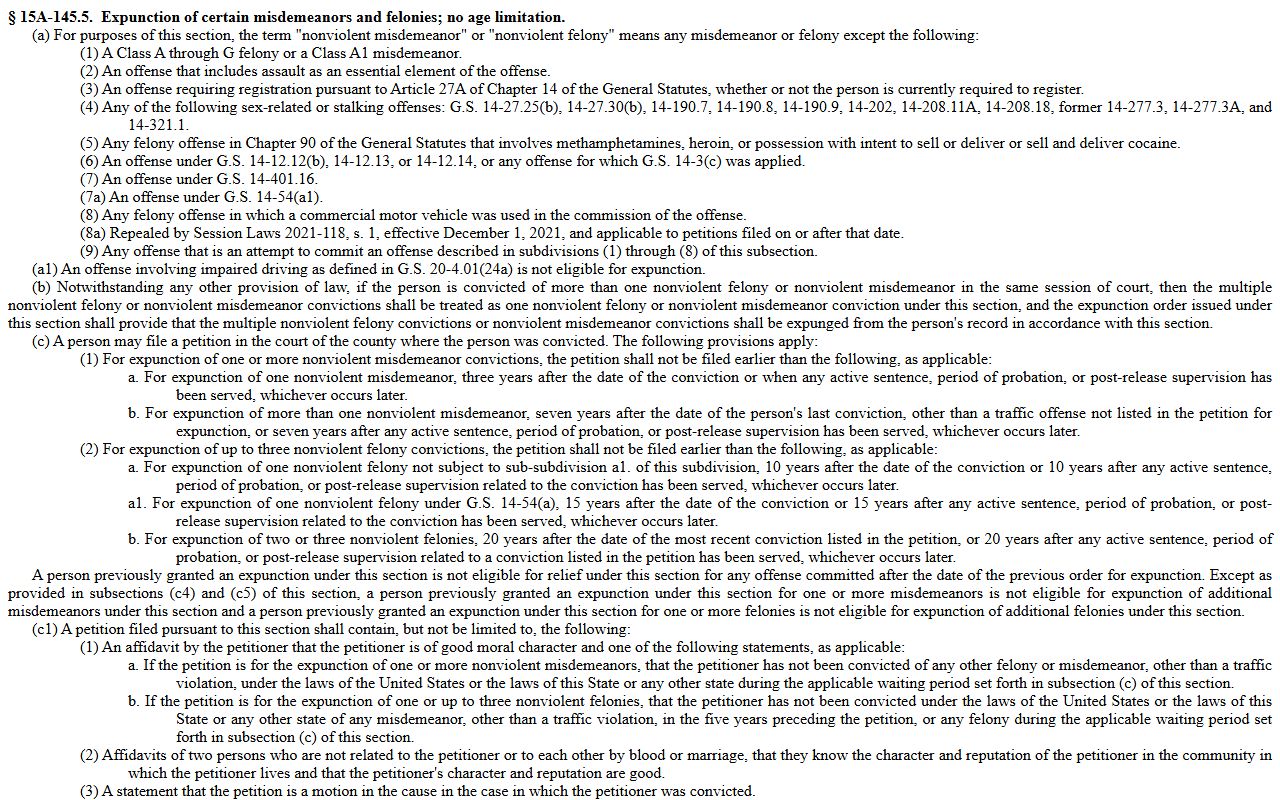
Anyone seeking an expunction in Buncombe County files the petition with the Clerk of Superior Court at 60 Court Plaza, Asheville. The process often requires affidavits, service on the District Attorney, a criminal record check, and a judge's order before the record drops from public view.
The Expunction Process in Buncombe County
Filing an expunction petition in Buncombe County follows a process that varies by statute category but shares common steps. North Carolina does not run expunctions automatically. A person must file in the correct county with the correct form and meet all eligibility rules for the specific statute that applies to their case. Common reasons petitions are denied include filing under the wrong statute, an ineligible offense class, additional disqualifying convictions, unpaid court costs, or an insufficient waiting period.
- Confirm eligibility. Identify the correct statute (15A-145, 15A-145.4, 15A-145.5, or 15A-146 are the most used) based on the offense, case outcome, and the person's age at the time.
- Obtain the petition form from the Clerk of Superior Court at 60 Court Plaza, Asheville, NC 28801, or from the N.C. Judicial Branch expunction forms page. Call (828) 259-3400 to confirm the current form number.
- Gather required documents. Depending on the statute, these may include an affidavit of good character, a criminal history report, and proof of any required waiting period.
- File the petition with the Buncombe County Clerk of Superior Court. Pay any filing fee required. The Clerk will serve a copy on the District Attorney's Office at (828) 259-3410.
- Attend any hearing the court schedules. A judge reviews the petition and may allow the District Attorney to object. Some petitions are ruled on without a hearing.
- If the order is granted, the Clerk directs relevant agencies to remove or seal the qualifying record. If the record is still visible weeks later, the petitioner may contact the Clerk to confirm transmission.
The N.C. Judicial Branch publishes an expunction help page at nccourts.gov/help-topics/court-records/expunctions with current information on eligible categories and forms.
Restricted Criminal Records in Buncombe County
Several categories of criminal and related records stay off-limits to the public in Buncombe County. North Carolina law draws these lines at the state level, and they apply equally here. Juvenile delinquency and undisciplined adjudications are not public records. They may not be disclosed without a court order, and they do not appear in routine eCourts searches. The same restriction covers abuse, neglect, dependency, and termination of parental rights files under Chapter 7B. Adoption records are sealed under Chapter 48 and accessible only through the procedures that statute authorizes.
Grand jury proceedings and sealed indictments are not public until the court unseals them, which usually happens at arrest or arraignment. Sealed warrants stay out of public view until they are served. Mental health commitments and incompetency proceedings have limited public access. Certain domestic violence victim details may be withheld from the public file to protect safety. Expunged records, as described in the section above, drop from public search after an order is entered and are treated as if the underlying event did not occur for most civil and employment purposes. If a search pulls a record that looks like it should have been expunged, the person may contact the Clerk of Superior Court in the county where the expunction was granted.
Ongoing law enforcement investigation records, confidential informant information, security plans, and filings containing Social Security numbers or financial account data can also be withheld or redacted under the specific exemptions in Chapter 132 and related statutes.
Buncombe County District Attorney and Public Defender
Buncombe County is Prosecutorial District 40. The District Attorney's Office sits at the Buncombe County Courthouse, 60 Court Plaza, Asheville. The DA prosecutes criminal cases in both Superior Court and District Court for Buncombe County. The office phone is (828) 259-3410, and staff are available Monday through Friday, 9:00 AM to 5:00 PM. People with questions about a pending Superior Court case who are not represented by an attorney may call the DA's Office or reach the Clerk of Superior Court at (828) 259-3400. The Buncombe County District Attorney's Office website describes the office's mission as seeking justice through fair, equal, vigorous, and efficient enforcement of criminal laws with public safety and victims' rights as top priorities.
The Buncombe County DA office website and its services page are the right starting points for anyone with questions about how the office handles prosecutions in Buncombe County.
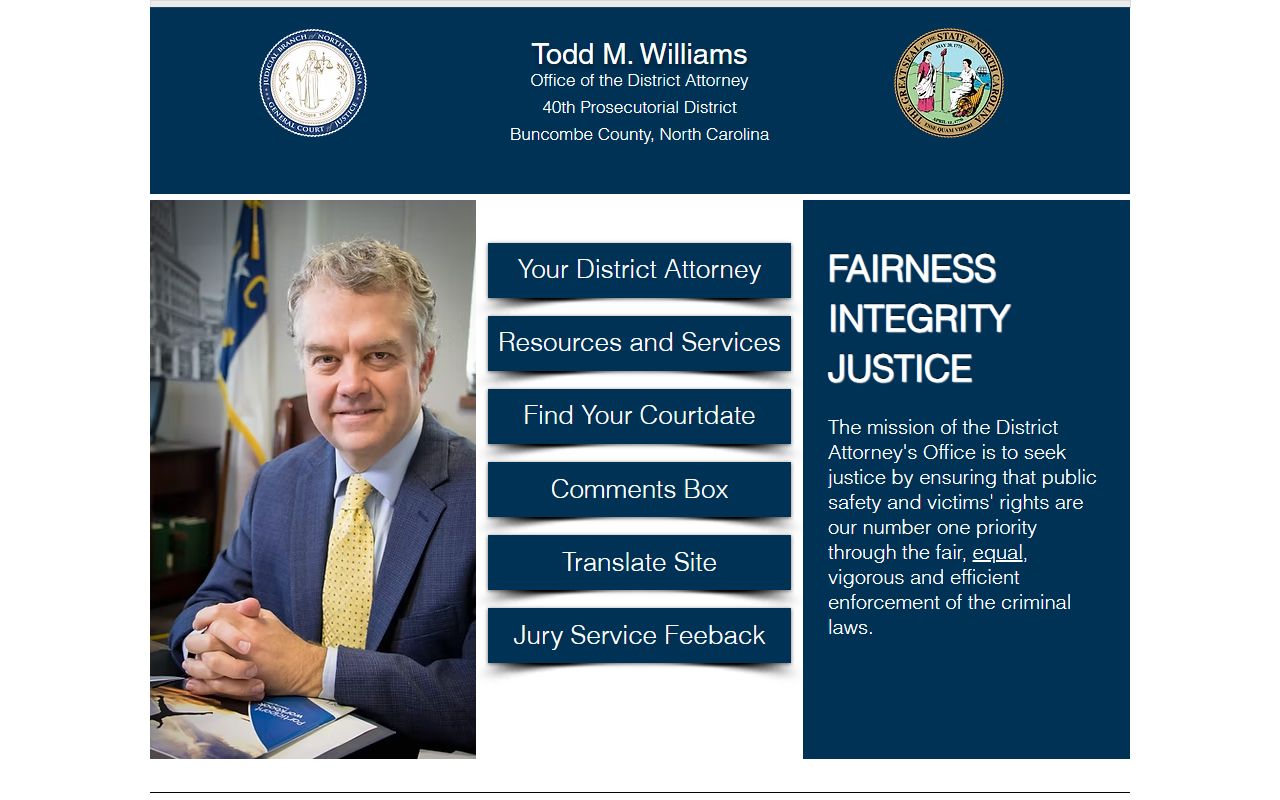
The office website includes a services page that outlines how the DA interacts with witnesses, victims, and the public in cases pending before the Buncombe County courts.
The Office of the Public Defender serves people who qualify financially and face criminal or other eligible charges in Buncombe County. Samuel "Sam" Snead has served as Chief Public Defender since October 1, 2020. The Public Defender's Office phone is (828) 259-3423. The N.C. Judicial Branch announcement of Snead's appointment is available on the court system's press-release page.
The N.C. Judicial Branch press release confirming Sam Snead's appointment as Chief Public Defender for Buncombe County, effective October 1, 2020, is the official record of the office leadership.
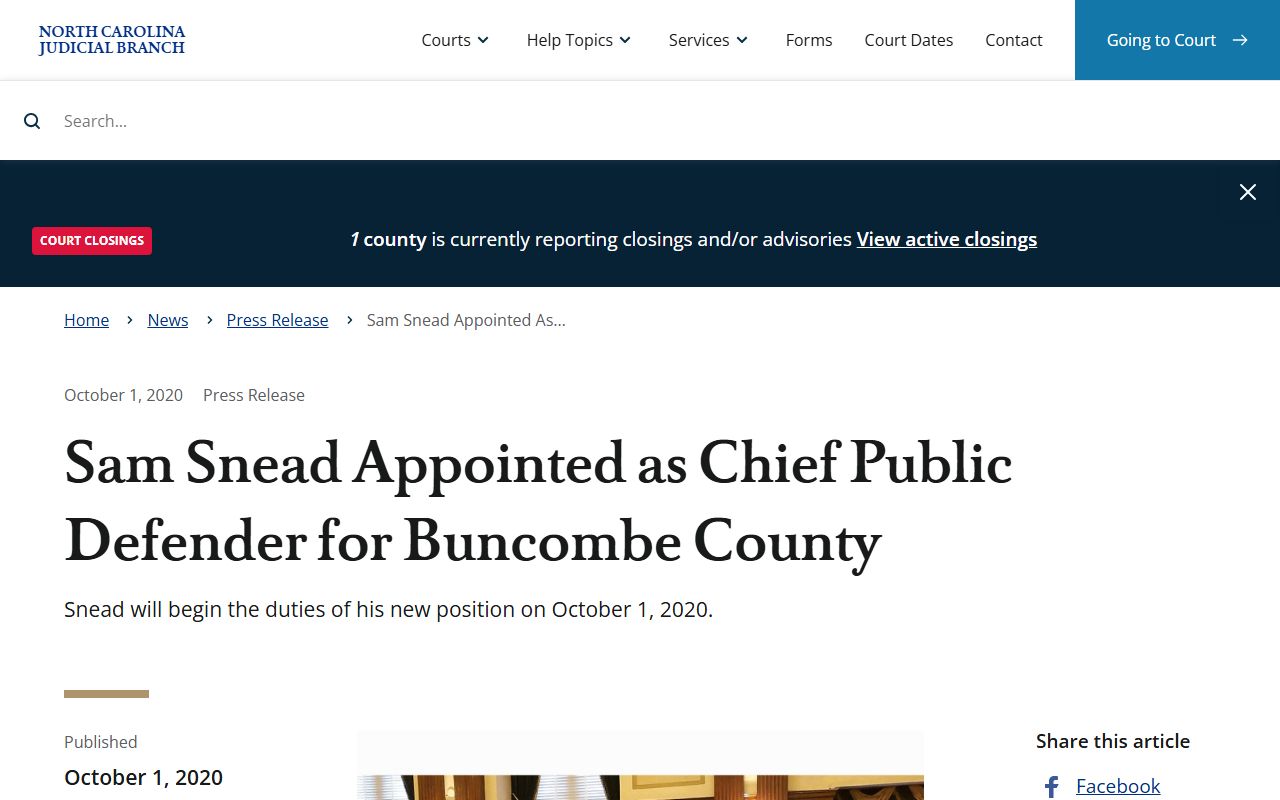
Appointment by the N.C. Judicial Branch means the Public Defender is part of the state court system, separate from the county government, and represents eligible defendants at no cost in qualifying Buncombe County criminal proceedings.
The Buncombe Family Justice Center provides services for victims of domestic violence, sexual assault, and elder abuse, including law enforcement, legal services, and safety planning, all at one site. It is a separate resource from the DA and Public Defender but relevant to many Buncombe County criminal cases involving these offense types.
DUI, DWI, and Traffic Arrest Records
Driving while impaired arrests in Buncombe County are criminal arrests, not traffic citations. A DWI charge gets filed in District Court as a criminal matter and appears in both the booking system and the eCourts criminal record. This is a key distinction. A standard speeding or equipment violation is a traffic infraction handled through the civil traffic side of District Court. A DWI is criminal from the moment of booking. The two records live in different parts of the same eCourts system but require different searches to find. Traffic infraction records are covered on the Buncombe County traffic court records page. DWI arrests follow the criminal records path described here.
Buncombe County also runs a DWI Treatment Court through Judicial District 40 for eligible repeat impaired-driving defendants. That program adds monitoring, treatment, and judicial accountability as alternatives to standard criminal sentencing.
Background Checks and Buncombe County Criminal Records
Arrest records found through the Police-to-Citizen portal or the eCourts Portal are public records. They are not the same as a formal background check run under the Fair Credit Reporting Act. FCRA-regulated background checks are used for employment, housing, credit, insurance, and similar decisions. Those checks have specific rules about accuracy, dispute rights, and how far back they can look. Official court records and booking data accessed directly from government portals do not carry FCRA obligations on their own, but any report compiled and sold about a person for employment or housing use almost certainly does.
Important: This website is not a consumer reporting agency under the FCRA and information here may not be used for employment, housing, credit, or insurance decisions.