
Active Buncombe County Warrant Records
Buncombe County does not publish a clean, separately indexed active warrant list on any official government website located through the official court and sheriff pages. That is a common situation across North Carolina. Warrants are judicial documents produced by magistrates or judges, and their public availability depends on whether they have been served and whether a related court case is open and searchable. Until a warrant is executed, it typically remains tied to a pending case file rather than a standalone public database.
What Buncombe County does offer is access through several connected systems. The North Carolina eCourts Portal holds case records for the Clerk of Superior Court, including criminal cases that carry warrant activity. The Buncombe County Sheriff's Police-to-Citizen inmate inquiry tool confirms whether someone is currently in custody at the Buncombe County Detention Facility, which is useful after a warrant has been served. The Clerk of Superior Court at (828) 259-3400 can confirm court-date and case-status information for known cases. These systems work together rather than as a single warrant-search portal.
The eCourts system went live across all 100 North Carolina counties on October 13, 2025, running on the Enterprise Justice and Odyssey platform. Every Buncombe court case, including those with warrant activity, is now searchable in one place. If a warrant connects to a court case, the case record in eCourts will reflect the current status of that matter.
The statewide North Carolina eCourts Portal is the front door for any Buncombe case tied to a warrant.
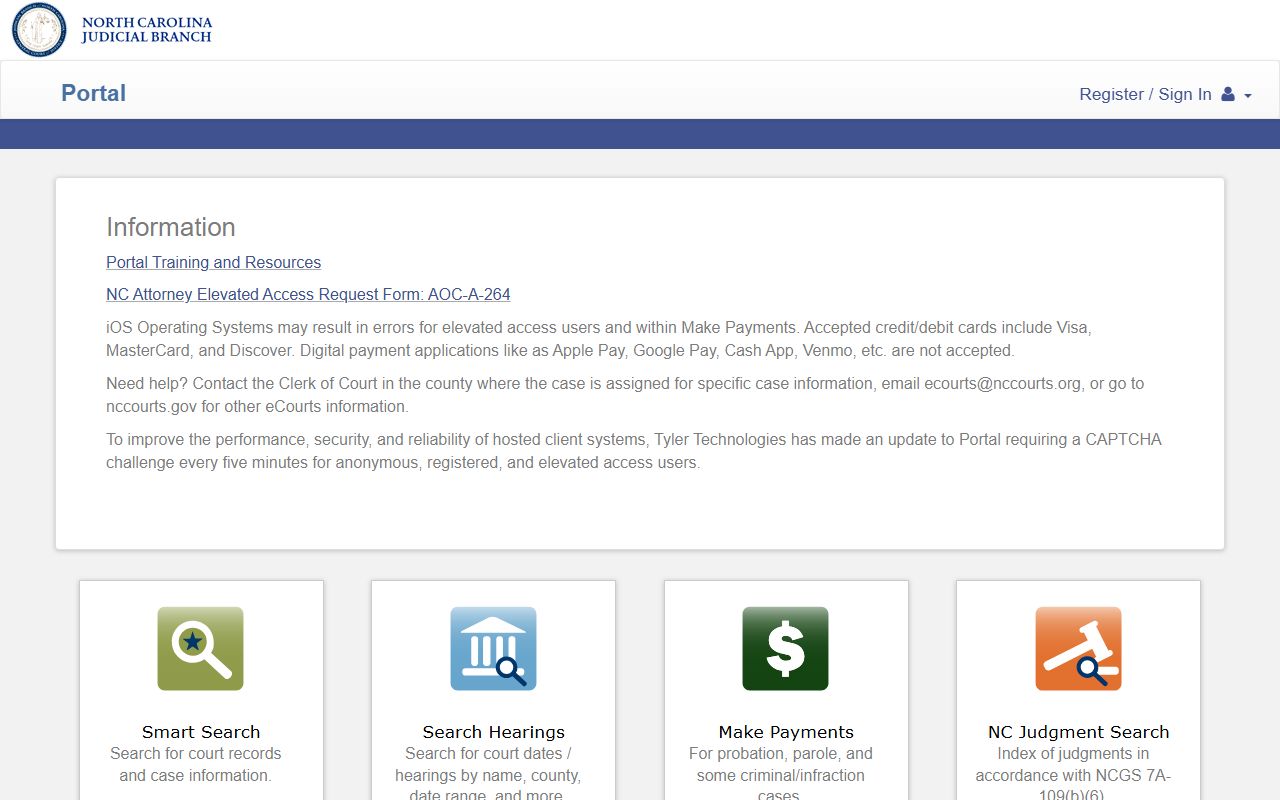
From that portal, Smart Search pulls the case record, and Search Hearings shows the next court date for a matter that carries warrant activity.
The Buncombe County Sheriff's Police-to-Citizen Inmate Inquiry page is the official way to confirm current custody at the detention facility after a warrant has been acted on. The P2C tool confirms booking status after arrest. It is not a forward-looking warrant list, but it is the fastest way to verify whether someone is currently held at 20 Davidson Drive following a warrant's execution.
Note: The official pages located during research do not publish a current booking timestamp or update frequency for the P2C inmate catalog.
Types of Warrants in Buncombe County
North Carolina law recognizes several distinct warrant types, and each one originates from a different legal situation. Knowing which type may be at issue helps narrow down the right office to contact and the right portal to search. Most warrant activity in Buncombe County flows through magistrates, District Court judges, or Superior Court judges depending on the severity and stage of the case.
- Arrest warrant - issued by a judicial official, usually a magistrate, after a finding of probable cause that a person committed a crime.
- Search warrant - governed by N.C.G.S. Chapter 15A, Article 11; authorizes law enforcement to search a specified location for named property, persons, or evidence.
- Order for arrest / bench warrant - issued by a judge or the Clerk when a defendant fails to appear for a scheduled court date or violates a court order; carries financial penalties in addition to the rearrest risk.
- Probation violation warrant or order - issued when a probationer is alleged to have violated the terms set at sentencing; routes back through the original sentencing court.
- Fugitive warrant / out-of-state hold - a hold placed on a person wanted in another jurisdiction; handled through the Sheriff's extradition process rather than the local court calendar.
- Sealed warrant or indictment - not public until service or a court-authorized unsealing; will not appear in eCourts public search until the sealing is lifted.
The N.C. Judicial Branch District Court page confirms that magistrates issue warrants for arrest and set bail as part of their core functions. The Clerk page notes that failure to appear can generate an order for arrest with a financial penalty attached. Both outcomes are searchable in eCourts once a case number is assigned.
How to Search Buncombe County Warrants
The primary tool is the North Carolina eCourts Portal Smart Search, which pulls case records from the Clerk of Superior Court system for all 100 counties including Buncombe. The Portal is free and does not require an account. A second tool, eCourts Search Hearings, lets you look by party name or case number to find upcoming court dates that may be tied to a warrant. The Police-to-Citizen Inmate Inquiry is the third official option and shows current custody status at the Buncombe County Detention Facility.
- Go to the North Carolina eCourts Portal and select Smart Search from the main dashboard.
- Enter the person's name in Last, First Middle Suffix format, or enter a known case number if you have one.
- Click Advanced Filtering Options and set the location filter to Buncombe County to narrow results to local cases.
- Apply a case type filter such as Criminal or Traffic if you know the underlying offense category, and set a status filter if you want only open or active cases.
- Review the case record for hearing dates, docket entries, and any notation showing an active warrant, failure-to-appear, or order for arrest.
- If custody status is the question, open the P2C Inmate Inquiry in a separate tab and search by name to confirm current booking at the detention facility.
- Call the Clerk of Superior Court at (828) 259-3400 if the portal result is unclear or if you need to verify whether a specific warrant has been served.
The Portal requires JavaScript and cookies enabled in your browser. A CAPTCHA challenge appears roughly every five minutes. Wildcard searches for names need at least three last-name letters followed by an asterisk and at least one first-name letter followed by an asterisk. Case number wildcards need at least four characters.
Buncombe County Warrant Search Fields
Buncombe County warrant searches run through two eCourts tools and the P2C inmate catalog. Each system accepts different input and returns different data. The table below comes from the official search fields identified for the Buncombe County warrant search tools during research. Note that P2C is an Angular/JavaScript application and its full form controls are not exposed in static HTML, so the inmate inquiry fields listed reflect the documented lookup pattern rather than a static form inspection.
| Field Label | Type | Required | Options / Format Notes |
|---|---|---|---|
| eCourts Smart Search | Web search | One criterion minimum | Search by record number or name; filter to Buncombe County; use case type or status if known to narrow results. |
| eCourts Search Hearings | Web search | Location, hearing type, and search type required | Search by party name, case number, attorney, judicial officer, or courtroom; returns scheduled hearing dates tied to cases. |
| P2C Inmate Inquiry | Web application | Unspecified | Confirms current custody after arrest and book-in; not a comprehensive or forward-looking warrant list. |
The N.C. General Statutes governing search warrant procedures are in Chapter 15A, including Article 11 for search warrants. That chapter also covers arrest warrant requirements and magistrate functions under the broader procedural framework.
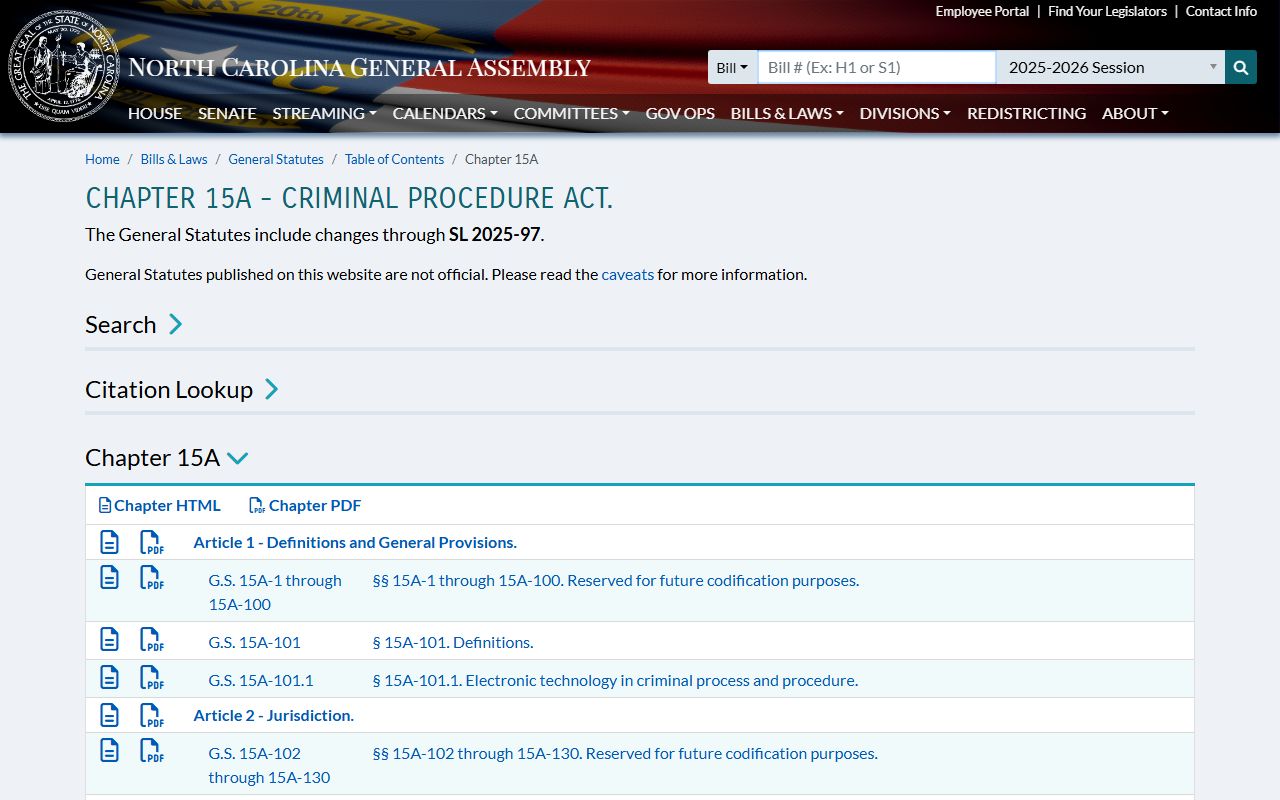
Chapter 15A, shown above on the N.C. Legislature site, is the core procedural law for warrants in Buncombe County and statewide, covering everything from probable cause findings to search warrant execution rules.
What a Buncombe County Warrant Record Shows
When a warrant appears in a court case record through eCourts, it is part of the larger case file rather than a standalone document. The fields a public user can see vary by case type and by whether the warrant has been served and the case has progressed to the filing-and-docketing stage. Based on the general fields documented for Buncombe County warrant records, here is what a warrant-related case record typically surfaces in eCourts. These are the documented general fields from research; verify current portal display against the live eCourts system before relying on the list.
| Field | What It Shows |
|---|---|
| Name | The person named in the warrant or order. |
| Case Number | The Clerk's file number assigned when the case was opened; use this to track all activity in eCourts. |
| Charge | The offense or statute cited as the basis for the warrant. |
| Issuing Court / Judicial Officer | The magistrate, District Court judge, or Superior Court judge who signed the warrant or order. |
| Issue Date | The date the warrant was signed by the issuing official. |
| Bond / Release Conditions | The bail amount or conditions set at the initial appearance before a magistrate, if applicable. |
| Service Status | Whether the warrant has been served; an unserved warrant means the person has not yet been taken into custody. |
| Related Court Date | Any scheduled hearing date tied to the case, viewable through eCourts Search Hearings. |
Certified copies of court documents, including warrant-related filings, must come from the Clerk of Superior Court at 60 Court Plaza, Asheville, NC 28801. Online eCourts results are not certified and cannot substitute for official court copies in legal proceedings.
What to Do About an Outstanding Buncombe County Warrant
An unresolved warrant does not go away on its own. It stays active in the system until it is served, recalled, or otherwise addressed by the court. Acting quickly and through the right channels gives a person the best chance to resolve the matter without an unexpected arrest in a public setting. The steps below come from the official guidance on the Buncombe County Clerk page and the DA office page for missed court dates and pending criminal matters.
Important: Consult a defense attorney before taking any step toward surrender; an attorney can often negotiate bond terms or a recall of the warrant before you appear.
- Do not rely only on third-party websites to confirm whether a warrant exists. Use official sources only.
- Search eCourts Smart Search for related cases by name or case number with the Buncombe County location filter applied.
- Contact defense counsel if you are already represented in the case; your attorney is the fastest way to get accurate information on what the warrant covers.
- Contact the Clerk of Superior Court at (828) 259-3400 for court-date and case-status questions related to a known case file.
- Contact the District Attorney's office at (828) 259-3410 if you are unrepresented and the missed appearance is tied to a pending criminal case; the DA page notes that unrepresented people with Superior Court questions may call that line Monday through Friday, 9 AM to 5 PM.
- For current custody or booking status, use the P2C Inmate Inquiry or call the Buncombe County Detention Facility at (828) 250-4550.
- If turning yourself in, confirm the location, hours, bond-posting rules, and property restrictions with the facility before you arrive; the Criminal Magistrate at (828) 250-4690 handles initial appearances and bail settings at the detention facility.
The Public Defender's office at (828) 259-3423 can assist eligible individuals who cannot afford private counsel. For people who need help navigating the process after release, Buncombe County's Jail Diversion and Re-Entry Services office is at 60 Davidson Drive, (828) 250-4587.
Note: If a warrant is tied to a probation matter, your supervision officer and the sentencing court are the first contacts, not the Clerk's general line.
Magistrates and Buncombe County Warrant Issuance
Magistrates play a central role in how warrants enter the Buncombe County court system. Under North Carolina law and as confirmed on the N.C. Judicial Branch District Court page, magistrates issue arrest warrants when they find probable cause, set bail at an initial appearance, accept guilty pleas for minor misdemeanors and infractions, and hear small claims matters. The Criminal Magistrate at the Buncombe County Detention Facility handles the initial appearance for people brought in after an arrest, setting bond and informing the person of their rights.
When a person fails to appear in District Court or Superior Court after being properly noticed, the presiding judge can issue an order for arrest on the spot. The Clerk enters that order into the system, and it functions as a bench warrant. The Clerk page warns explicitly that a failure to appear can result in an order for arrest and a financial penalty. These orders show in eCourts under the original case number.
Magistrates sit at 60 Court Plaza for civil matters and at the detention facility at 20 Davidson Drive for criminal matters. The Criminal Magistrate line is (828) 250-4690. Both magistrate functions connect to the same eCourts system that powers the public warrant search.
Criminal Magistrate
Buncombe County Detention Facility
20 Davidson Drive
Asheville, NC 28801
(828) 250-4690
Clerk of Superior Court
Buncombe County Courthouse
60 Court Plaza
Asheville, NC 28801-3519
(828) 259-3400
Mon-Fri 8:00 AM-5:00 PM
District Attorney
Prosecutorial District 40
60 Court Plaza
Asheville, NC 28801
(828) 259-3410
Mon-Fri 9:00 AM-5:00 PM
Sealed and Restricted Buncombe County Warrant Records
Not every warrant is visible in eCourts public search. Sealed warrants and sealed indictments are withheld from public access until they are served or until a court authorizes their unsealing. A search that shows no result does not rule out the existence of a sealed warrant. This is an important distinction when using eCourts to confirm warrant status, since the absence of a public record is not the same as the absence of a warrant.
Several other categories are also restricted in Buncombe County and statewide. Juvenile delinquency and undisciplined records are not public records under N.C.G.S. Chapter 7B, Article 30, and arrest or warrant records connected to juvenile matters follow the same confidentiality rules. Grand jury proceedings and related materials are sealed from public view until charges are formally filed. Confidential informant information embedded in warrant applications is routinely redacted from any copy a public requestor receives. Expunged records, including cases in which a warrant was issued but the underlying charge was later expunged, are removed from public court-system sources after the expunction order is processed and verified.
Fugitive warrants and out-of-state holds involve another jurisdiction's court records as well, which adds a layer of complexity. If the underlying charge is from another state, the warrant details in Buncombe's eCourts system may reflect only the hold, not the full charging information from the originating court.
For a broader look at what court records are restricted in Buncombe County, see the court records page and the arrest records page, which cover expunction and sealing procedures in more detail.